

Our Work
Founded in 2014, the Center on Privacy & Technology is a leader at the intersection of privacy, surveillance, and civil rights.
Latest Work
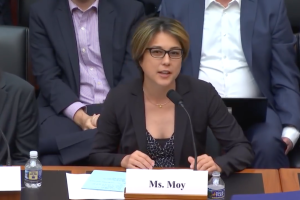
Testimony for hearing “How to Prevent Future Harms to Consumer Data” before U.S. House Committee on Financial Services by our Deputy Director
On October 25, 2017, the U.S. House Committee on Financial Services held a hearing entitled "Examining the Equifax Data Breach." Deputy Director Laura Moy's testimony provided policy recommendations that seek to prevent future harms to consumer data. Watch the full video recording.

House of Representatives Hearing on the Equifax Data Breach
Deputy Director Laura Moy testified on privacy and data security before the House Finance Committee. She called for enhanced rulemaking and enforcement authority for federal agencies that oversee data security, and cautioned Congress against establishing new data security protections that eliminate important existing protections.

The Color of Surveillance: Government Monitoring of American Immigrants
The second annual Color of Surveillance conference examined the issue of government surveillance of American immigrants. The event encompassed historical perspectives of immigrant surveillance in the 20th and 21st Centuries and included a discussion with Professor Xiaoxing Xi, a US-based physics professor who was falsely accused of being a spy.
National Civil Rights Leader to Address Georgetown Law Conference on Surveillance of Immigrants
In June 2017, the Privacy Center hosted "The Color of Surveillance: Government Monitoring of American Immigrants." The conference, which featured a keynote address by Vanita Gupta, explored the surveillance of immigrants from the late 19th century to the present. Read the full press release,
Privacy Center Files Lawsuit for Release of Information on NYPD’s Face Recognition Program
On May 2, 2017, the Privacy Center filed a lawsuit against the New York Police Department (NYPD) for failure to release documents about its use of face recognition technology in compliance with the state's public records law. Read the full press release.

Center on Privacy & Technology v. NYPD
The Center sued the New York City Police Department under the state's Freedom of Information Law for the department's refusal to disclose records pertaining to its use of face recognition technology. Litigation is ongoing.
Privacy Center Executive Director Testifies at House Oversight Hearing on Law Enforcement Use of Face Recognition Technology
On March 22, 2017, founding Executive Director Alvaro Bedoya testified before the House Oversight Committee. The hearing follows the Privacy Center's publication of "The Perpetual Line-Up," which found that more than half of Americans is in a criminal face recognition network. Read the full press advisory.
Over Half of All American Adults Are In a Police Face Recognition Database, New Report Finds
On October 18, 2016, the Privacy Center released "The Perpetual Line-Up: Unregulated Police Face Recognition in America." Authored by Associate Clare Garvie, Executive Director Alvaro Bedoya, and Staff Technologist Jonathan Frankle, the report found that more than half of American adults were enrolled in a face recognition network searchable by law enforcement. Read the full press release.

The Color of Surveillance: Government Monitoring of the African American Community
The inaugural Color of Surveillance conference focused on the disproportionate amount of government surveillance on the African American community. It hosted robust conversations on the historic and current surveillance of this group, including a debate between a Pulitzer-winning MLK biographer and the general counsel of the FBI.
Comment to the FTC on Lead Generators
Clare Garvie and Founding Director Alvaro Bedoya filed a comment which examines how online lead generation creates and perpetuates the disparate impact of payday loans on African American borrowers. They urged the FTC to use its authority under ECOA and Section 5 of the FTC Act to investigate and bring enforcement actions against responsible companies.