Orientation 2026: Georgetown Law Welcomes 900+ ‘Hoya Lawyas’ to Campus
August 31, 2026
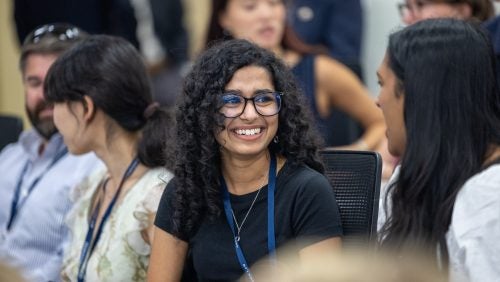
J.D. students connected with new classmates at section-specific welcome sessions.
Some 600 new J.D. students and 275 LL.M. students began their Georgetown Law journeys August 18 at Orientation, which offered welcome activities, classroom introductions, city tours and social gatherings for incoming students as they arrived on campus.
This year’s admissions cycle was historically competitive, with new J.D. students selected from a pool of nearly 14,500 applicants — the highest number of applications ever received. The 1Ls hail from 49 U.S. states and 20 foreign countries, and one in eight are first-generation college graduates. The entering class also includes 27 members of the military and 73 Evening Program students, who will earn their law degrees while working full-time. The LL.M. class includes individuals from more than 43 countries around the world who speak more than 34 different languages.
“You are learning how to become people whom others will trust — with their problems, their businesses, their families, their liberty, their institutions, ” said Dean M. Elizabeth Magill in her welcome remarks to each J.D. section. “You’ll hear a phrase around Georgetown Law: ‘Law is but the means; justice is the end.’ I suspect that sentence will mean something different to you three years from now than it does today. I hope you’ll keep thinking about what it asks of you.”
Getting to know the nation’s capital
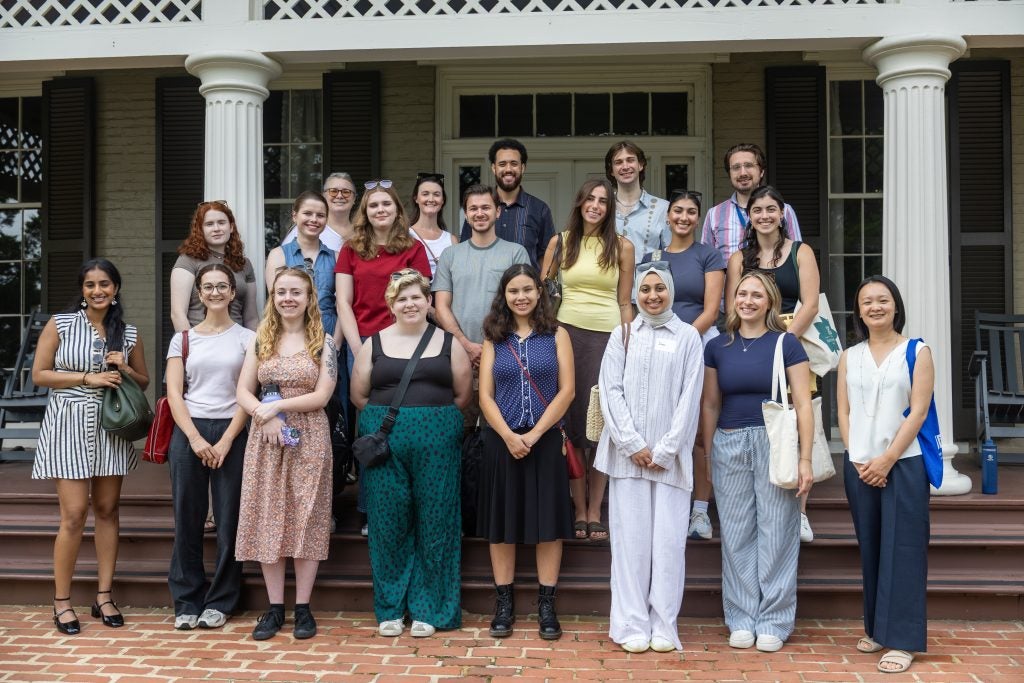
Students joined faculty and staff from the Human Rights Institute for a guided tour of the Frederick Douglass National Historic Site in nearby Anacostia. “Especially given that my work overlaps heavily with the interests of many in the Human Rights Institute, I wanted to meet these people,” said participant Alex MacKenzie, L’30.
Orientation got underway with a series of city tours and community service projects, including a walking tour of iconic Capitol Hill buildings led by Librarian for the Supreme Court of the United States David Mao, L’93; a volunteer shift in the food pantry at the Father McKenna Center; and the chance to take in art and history at nearby museums.
Some 20 students joined faculty and staff from the Human Rights Institute (HRI) for a guided tour of Cedar Hill, the home where Frederick Douglass spent the last 17 years of his life.
Students gave back to the community through service projects at local non-profits.
During the outing, students reflected on the enduring relevance of Douglass’s work in light of the 250th anniversary of the signing of the Declaration of Independence and the fight for human rights in the U.S. and around the world.
Evening student and Tech Law Scholar Alex MacKenzie, L’30, took the morning off from his role as an operations research analyst for the D.C. Department of Corrections in order to join the tour, which he said offered a “fascinating” look at Douglass’s life and work. “When I was looking at the list of tours, I was prioritizing tours I felt would teach me something new, and that had an interesting host,” he said. “This tour did both.”
For San Diego native and history enthusiast Nicole Manley, L’29, the chance to explore Cedar Hill and other museums during her first few weeks in D.C. proved both enriching and accessible. “It’s kind of a culture shock that all the Smithsonians are free. Where I’m from, that’s pretty rare,” said Manley, who is taking part in the alternative 1L “Curriculum B” offered by Section 3. “For someone who really loves museums in general, [D.C.] is kind of like a paradise.”
‘Exploration, not apprehension’
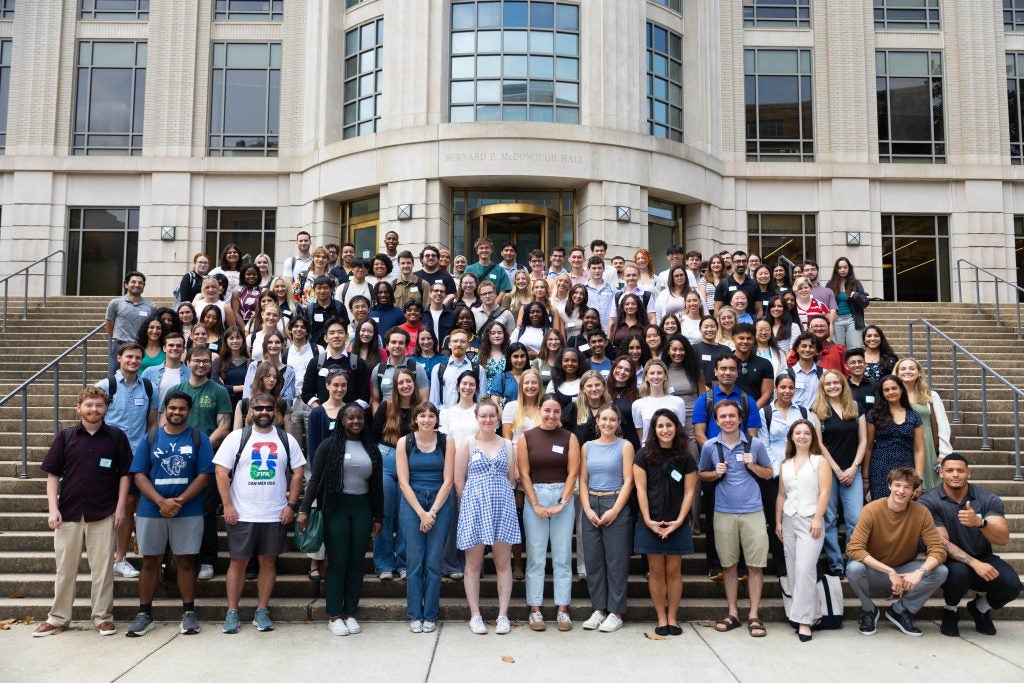
RISE students posed for a photo on the steps of McDonough Hall. “I wanted to build academic confidence and get comfortable on campus,” said evening program student Omeed Faegh, L’30, of the decision to take part in the program. “Above all, I hoped to connect with a supportive community of peers. RISE accomplished all of that and more.”
140 J.D. students also participated in a pre-orientation week organized by RISE, the Law Center’s program for students who may have had less exposure to the legal profession before applying to law school. The schedule for the program’s largest cohort to date included mock classes and exams, team-building activities and information sessions on topics such as career planning.
“I’m so thankful that my introduction to day-to-day life at Georgetown Law was through RISE,” said Hana Lee, L’29, who served on active duty for 14 years in the United States Army as an Aviation officer flying Black Hawk helicopters before coming to Georgetown Law. “I thought law school would be isolating at first, but between my RISE friends and the support from higher [up], I’m not stressed about the social aspect of school at all.”

At RISE pre-orientation week, students got acclimated to campus during mock classes and other welcome activities.
“The RISE pre-orientation program was incredible. The mix of light-hearted activities with professional and academically minded programming helped me learn about the Law Center, my classmates, faculty, staff and all the opportunities available to me over the next three years,” said Sara Rani Reddy, L’29, a first-generation law student whose interest in international human rights law was shaped by her experiences teaching English to primary and secondary school students, including Ukrainian refugees, as a Fulbright grant recipient. “The mock class helped dispel some of the anxiety around cold-calling and underscored that Georgetown Law classrooms are environments of curiosity and exploration, not apprehension.”
For LL.M. students, many of whom are foreign-trained attorneys, the chance to connect with classmates from dozens of countries and varied legal backgrounds also proved a high point of the week.
“The LL.M. cohort comprises a very accomplished cross-section of legal practitioners from across the world,” said Raphael Njoroge, L’27, a National Security Law LL.M. student whose career in international criminal and humanitarian law and cross-border dispute settlement has spanned Tanzania, Kenya and Switzerland. “I look forward to getting to know many or most of them throughout the rest of the year.”
“Meeting so many people from all around the world, being able to connect with them and making new friendships has been the highlight of my orientation week,” said Julia Arcagni, L’27, a General Studies LL.M. student and Argentinian attorney who developed an interest in the U.S. common law system during an internship at the Miami-Dade County Courthouse. “Washington, D.C. is such a relevant city for what we study, and being so close to where so much of this happens is truly thrilling.”
Building strategies for success
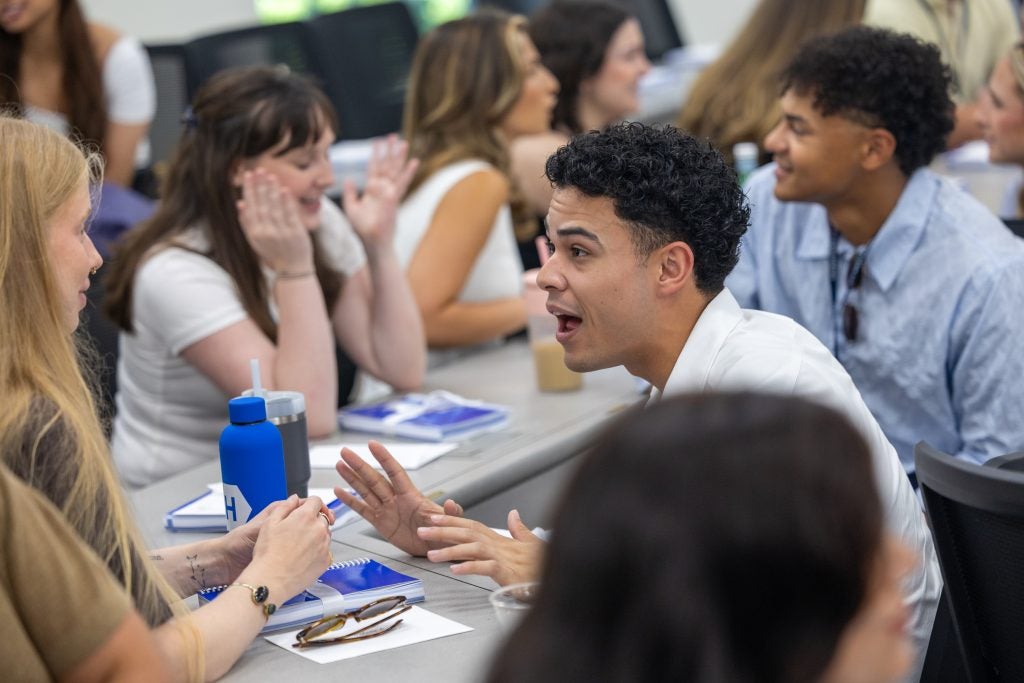
Incoming J.D. students received a copy of the Bluebook — a law-school essential — thanks to generous support from more than 200 alumni donors.
Having forged connections with classmates, students also had the chance to connect with professors at a series of faculty talks — spanning topics from artificial intelligence to asylum law — and “Introduction to the First-Year Experience” class sessions for J.D. students, which began with an hour of faculty instruction and ended with a discussion about what to expect from 1L courses.

The Bluebooks distributed at Orientation came topped with cards containing messages of support from alumni.
“What surprised and touched me the most this week was how remarkably warm and welcoming every single faculty member has been,” said Samina Khaliq, L’30. “They go out of their way to greet us with smiles and handshakes, crack jokes and put us completely at ease before we even step foot inside a classroom.”
“I did not know exactly what to expect about law school, except from what I have seen in pop culture, so I was so grateful to have several days devoted to getting advice from older students, listening to faculty talks from professors and meeting my peers before classes begin,” echoed Katerina Krizner, L’29. “Having so many opportunities to have my questions answered … reassured me about what is to come.”
Throughout the week, J.D. and LL.M. students received guidance on strategies for success inside and outside the classroom, including campus affinity groups, journals, clinics and opportunities such as externships and clerkships.

At a networking reception following Orientation, students met practicing attorneys — many of them Law Center alumni — from across the private and public sectors.
At “JD Careers: Support from the Start,” a series of interactive sessions organized by the Office of Career Strategy (OCS) and the Office of Public Interest and Community Service (OPICS), students were introduced to campus career resources and myths and realities about legal career paths. The sessions were followed by “Public Sector 101” and “Private Sector 101” talks, where career advisors from each office shared information with each J.D. section about recruitment and networking basics and opportunities in transactional law, litigation, government, non-profits and more.
“One of our goals in this session was to temper some of the anxiety and stress about careers that we know students are feeling as they start law school,” said OCS Assistant Dean Amy Jones Mattock of the “Support from the Start” sessions. “Our hope was to give them some strategies to stay true to their individual values, goals and aspirations while navigating a legal market that is going to require them to make career decisions very early in their law school career.”
“Another goal of ours was to highlight for students early on that many — if not most —careers toggle frequently back and forth between the private and public sectors,” added Assistant Dean for Public Interest Programs Morgan Lynn-Alesker, L’07. “We encouraged open-minded exploration — even if students currently have a tendency towards one sector or issue area — for skill development, networking opportunities and career satisfaction and longevity.”
Witnessing oral advocacy in action
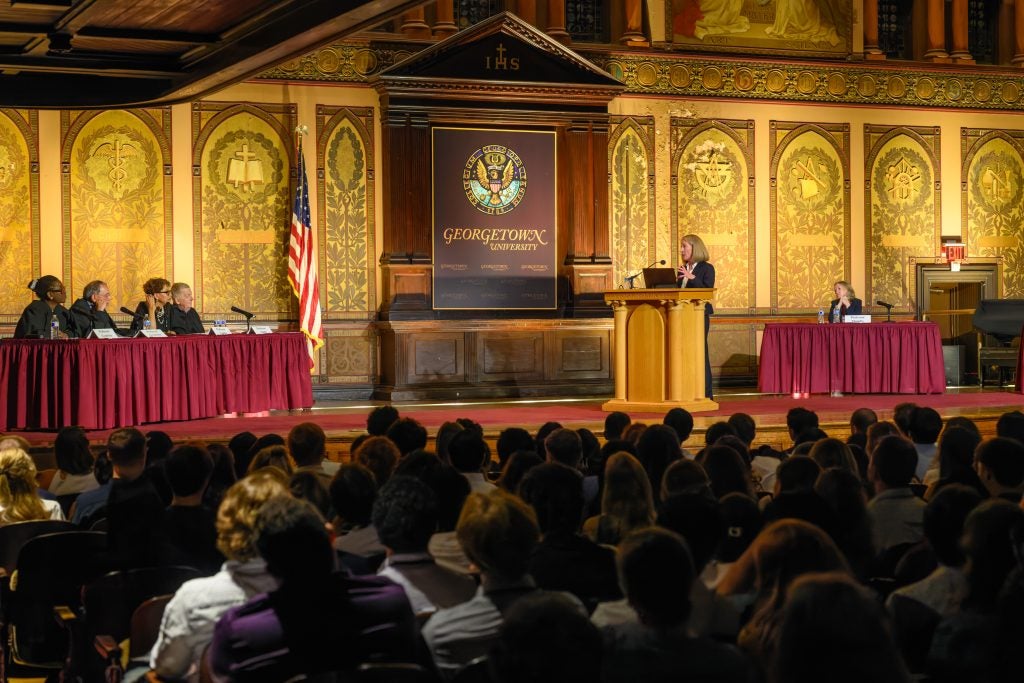
Professors took the stage in Georgetown’s ornate Gaston Hall at the Faculty Moot Court. Photo credit: RCS Photography.
For many, the chance to hear professors argue at the annual Faculty Moot Court was a much-anticipated highlight of the week. On August 20, incoming J.D. students gathered on the historic Hilltop Campus to watch Adjunct Professor Erin Murphy, L’06, represent the petitioner and Visiting Professor Mary McCord represent the respondent in Viramontes v. Cook County, Illinois, a case to be heard by the U.S. Supreme Court this fall concerning the right to own AR-15s and similar semiautomatic rifles.

Before the Moot, Dean Magill was joined by President Peñalver for a wide-ranging discussion about legal education and practice. Photo credit: RCS Photography.
Murphy and McCord delivered opening statements and fielded questions from a panel of “justices” that included Professor Michele Goodwin, Professor from Practice Irv Gornstein, Professor Sheryll Cashin and Visiting Professor from Practice Paul Smith.
“It was incredible to watch some of the most accomplished attorneys deliver their arguments with such grace and poise while being able to articulate such concise and well-researched points,” said Anika Thota, L’29, following the Moot.
“I was so impressed by the depth of our professors’ preparation as they argued a real Supreme Court case,” agreed Khaliq. “The acting justices asked brilliant, thought-provoking questions, making the entire enactment a captivating preview of high-level legal advocacy.”
The Faculty Moot Court was preceded by a conversation between Dean Magill and Georgetown University President Eduardo Peñalver, who reflected on their law school experiences and offered words of advice to students as they prepare to embark on their legal training.
“Hang on for the ride,” Magill urged those in attendance. “You really are learning entirely new mental furniture that’s going to live in your head thereafter, and intellectually [that’s] incredibly exciting.”
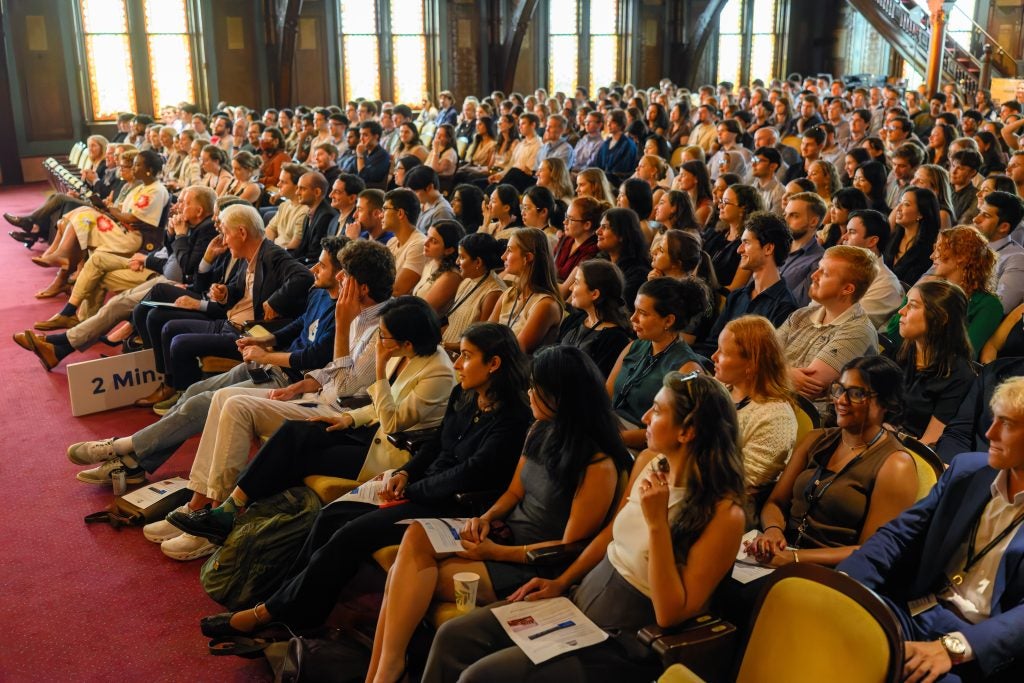
Students listened attentively to the Faculty Moot Court on August 20. Photo credit: RCS Photography.