‘A Special Bond’: Class of 2026 Graduates Reflect on Finding Belonging through Mentorship
May 11, 2026
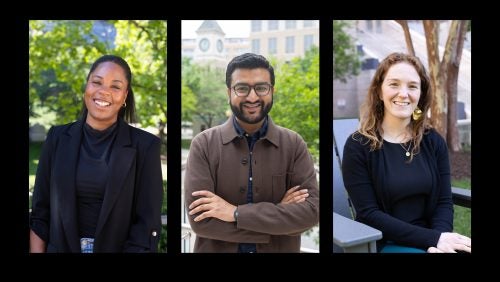
L-R: Kiarra Alleyne, L’26; Taha Syed, L’26; Hannah Holden, L’26
With more than 2,500 students, faculty and staff working across a campus that spans three city blocks, the Georgetown Law community is vibrant and vast, offering abundant opportunities for learning and hands-on experience in the nation’s capital.
That breadth also creates more opportunities for belonging on campus, where students pursue a range of academic and extracurricular activities — and form tight-knit communities around common interests — as part of more than 150 campus mentorship programs, journals, organizations, societies and affinity groups.
“Our hope is that every student gains meaningful connections and a sense of community at Georgetown Law, no matter their background or interests,” says Associate Vice President and Dean of Students Mitch Bailin, whose office helps oversee student organizations in which members explore everything from cyberlaw and civil rights to softball and a cappella singing.
“There can be a misconception that law students are competitive, that they don’t support one another,” he says. “But we see our students uplift each other every step of the way.”
Below, three Class of 2026 graduates reflect on building community on campus, mentorship in the classroom and beyond and how they’ve given back to the next generation of Hoyas.
Kiarra Alleyne, L’26
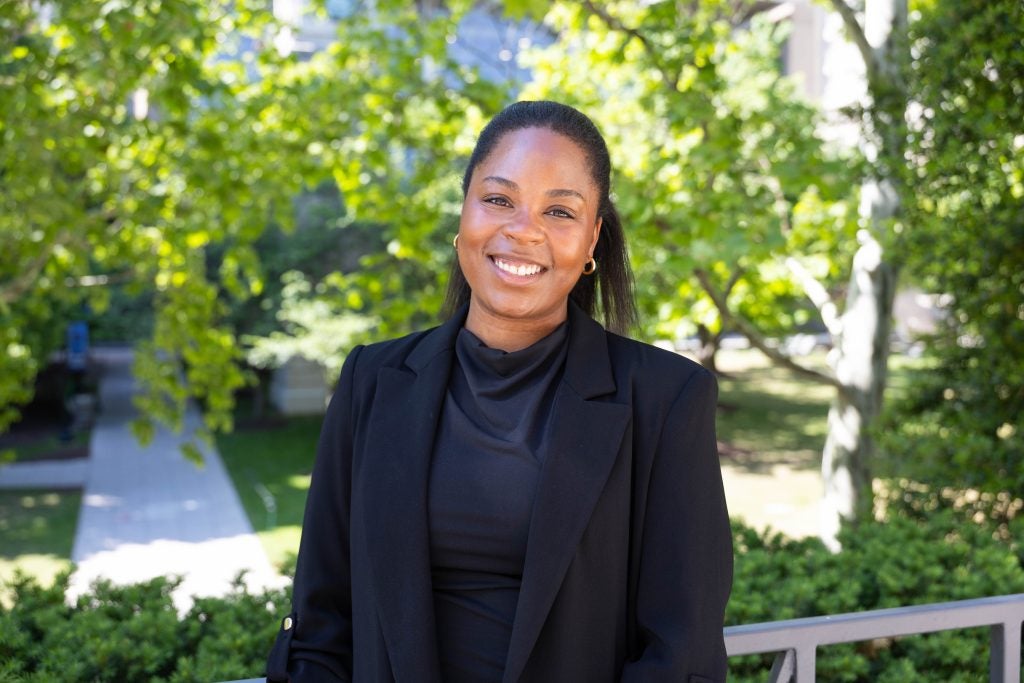
Kiarra Alleyne, L’26, supported — and learned from — 1L students during her year as an upper-division Legal Practice law fellow. “You’re mentoring the students, and then they’re mentoring you,” she says.
As a graduate student at the Columbia University Mailman School of Public Health, Kiarra Alleyne’s background in policy and research sparked an interest in legal advocacy. At Georgetown Law, that interest grew into a passion for legal writing.
“There’s a hard learning curve, but once you get it, you start seeing it in every single case that you read,” says Alleyne of learning to write — and think — like a lawyer in the first-year Legal Practice program, which teaches 1L students the foundations of legal writing and analysis through assignments that mimic real-world practice.
In addition to learning how to craft memos and persuasive briefs, first-year students receive guidance from upper-class law fellows, who offer substantive feedback to small groups of 10 or so students through office hours, one-on-one conferencing and written comments on assignments.
For Alleyne, that guidance was formative. “My law fellow was the sweetest, kindest person,” she says of the support she received from Erika Sloan, L’25. “From the first day, she [made it clear]: I’m here for you inside of the classroom, but also outside of the classroom — you can ask me anything.”
Thanks to Sloan’s example and encouragement, Alleyne applied to become a law fellow the following year. “Being a law fellow was my favorite experience about 2L,” Alleyne says, noting that she still keeps in touch with her former students — many of whom she now considers friends — to offer advice about classes, externships and more.
In her experience, the peer relationship between 1Ls and law fellows allows a special kind of mentorship to flourish. “It shows the 1Ls how quickly they’re going to be able to pick things up,” she says. “When the people that are helping you and giving you feedback are 2Ls, it helps students realize what they’re going to be able to accomplish in a year.”
Alleyne credits the Legal Practice program with motivating her to pursue a range of other activities during her time on campus, including serving as editor-in-chief of The Georgetown Journal of Gender and the Law and joining the Barristers’ Council moot court team. This semester, she took part in the Appellate Courts Immersion Clinic — and says the communication and collaboration skills she learned as a law fellow set her up for success in hands-on legal practice.
After graduation, Alleyne will remain in D.C. as a litigation association at Latham & Watkins LLP. As graduation approaches, she reflects on another upside of mentorship: the lasting bond she formed with her “fellow fellows” as they supported the first-year students in their respective cohorts.
“That’s an experience that you don’t typically get in law school, especially a school as big as Georgetown,” she says. “When you have 600 people in your class, the opportunity to work really closely with six people is unmatched.”
Taha Syed, L’26
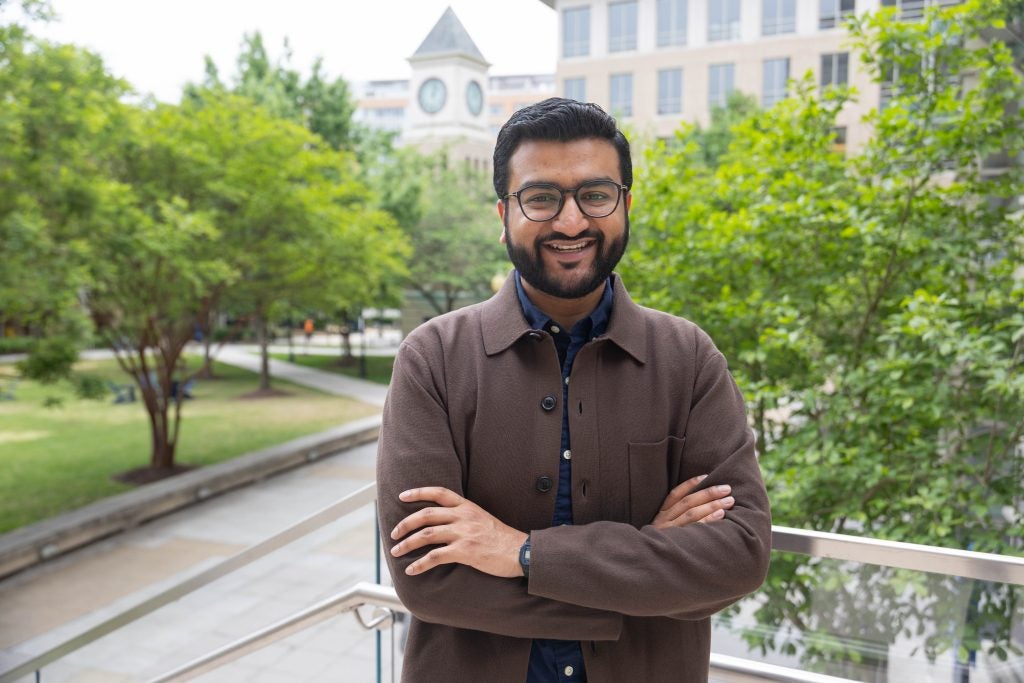
“If you find your community, they’ll be able to help you in ways that only students who have been through what you’ve been through can,” says Taha Syed, L’26, who has been involved in the Muslim Law Students Association and RISE program since his 1L year.
For Taha Syed, understanding the importance of giving back to his classmates means looking to the tenets of his Muslim faith.
“We have a saying: ‘God helps you as long as you’re in the service of His servants,’” says Syed, who has taken on mentorship roles through the Muslim Law Students Association (MLSA) and the RISE and Peer Advisor programs at Georgetown Law. “You can never repay the people who helped you, but you can pay it forward.”
After graduating from the University of Michigan in 2021 with a B.A. in economics, Syed worked in a sales and marketing role at Google, where his exposure to the overlap between issues in technology and the legal field spurred the decision to attend law school.
Syed recalls that he didn’t have much familiarity with the practice of law before coming to Georgetown Law. But taking part in RISE, which is designed to serve students who may have had less exposure to the legal profession before law school, filled that gap.
Through a robust pre-orientation program and formal and informal mentorship opportunities throughout the year, RISE students develop their academic and professional skills while building long-lasting connections with alumni, staff and classmates.
“A lot of people make their best friends in RISE … it’s a special bond,” Syed says, remembering how his RISE mentor, Rich Reynolds, L’24, and Reynolds’s twin brother, Ed Reynolds, L’24, took Syed on a walking tour of campus and Capitol Hill before orientation, stopping to take photos along the way. “[Rich] said, take these pictures and you’ll look back three years later and be reminded where you started.”
As a 3L, Syed has since mentored other RISE participants, helping them polish cover letters and resumes and reviewing course outlines. He also serves as an advisor to some 30 first-year students through the Office of Student Life’s Peer Advisor program, which pairs each 1L student with an upper-division advisor for individualized support starting at orientation.
Syed also points to MLSA as an invaluable source of support during his time on campus. In addition to hosting social events and holiday celebrations, MLSA provides a forum for Muslim students to navigate issues at the intersection of faith and legal practice, such as religious accommodations in the workplace.
“I can’t understate how important it was to receive recruiting and interviewing advice from [my] MLSA mentors Mohammad Shazeb, L’25, and Humza Yousuf, L’24,” says Syed, who has served as the group’s co-president this year. “When you’re in this type of affinity group, you get to know the upperclassmen really well. That creates a lot of channels for informal mentorship.”
After graduation, Syed will serve as a judicial clerk on the United States District Court for the District of Maryland before joining the New York offices of Simpson Thacher & Bartlett LLP as an associate. But first, he is looking forward to delivering the invocation to prayer on behalf of Muslim students at Commencement on May 17.
“It’s a big honor,” he says, noting that he will be following in the footsteps of another MLSA mentor, Azam Chaudry, L’24, who delivered the invocation in 2024. “I’m excited about being able to openly represent my community at graduation.”
Hannah Holden, L’26
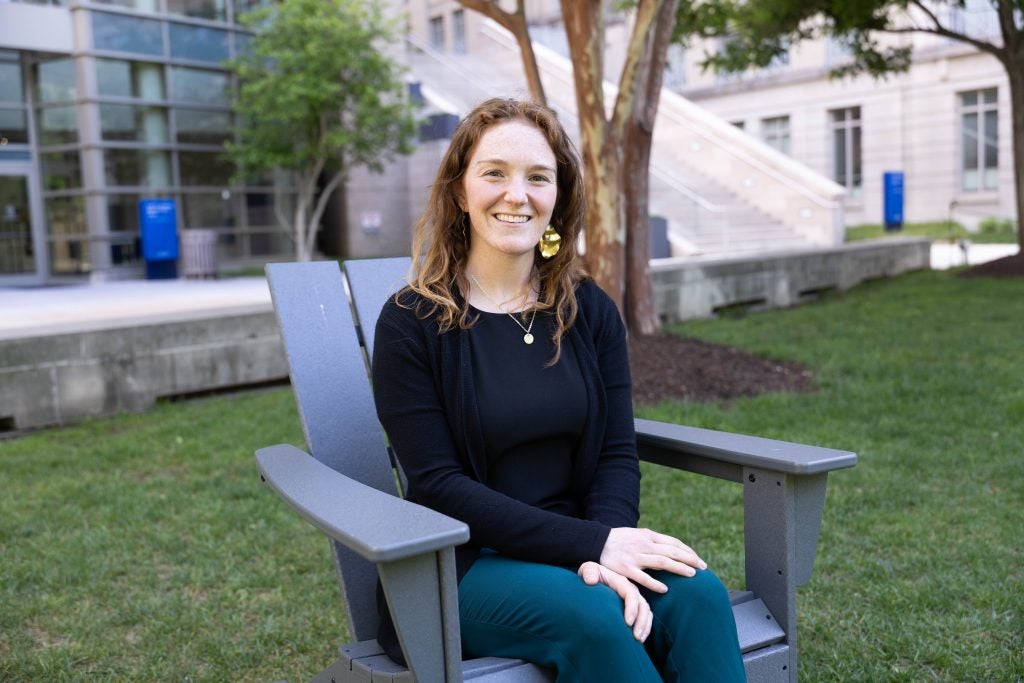
For Hannah Holden, L’26, the concept of “sympathetic joy” — rejoicing in the success and well-being of others — is at the core of her commitment to supporting other military-connected students on campus through the Military Law Society.
Hannah Holden long knew she wanted to pursue a career of service — and her time as a U.S. Army officer stationed in Germany and Poland galvanized her desire to become a lawyer.
“My soldiers were a huge motivation for me. I loved having their back no matter what,” says Holden, who earned a B.A. in applied linguistics in 2019 from the University of California, Los Angeles, where she trained as a Reserve Officers’ Training Corps (ROTC) cadet.
At Georgetown Law, Holden found her place among the tight-knit community of military service members and veterans, which includes a record-breaking fall 2025 1L class and students in both the full-time and evening programs who have served in the U.S. Army, Navy, Coast Guard and Air Force.
For military-connected students, the transition to law school can pose unique challenges. But Holden and others point to the Military Law Society (MLS) — which offers academic and career support and social and networking events, such as monthly happy hours — as a lifeline for its some 100 members.
In Holden’s case, the support started before her 1L classes began. At an orientation breakfast for military-connected students, Holden met then-MLS President Lucas Baker, F’24, L’24 — and discovered the two had been stationed in the same place during their Army service.
“He really took me under his wing,” she recalls of Baker’s mentorship. “I could reach out to him at any point and ask for advice. He took what precious little time he had to help me out — and others.”
Holden has since followed in Baker’s footsteps: Since the spring of her 2L year she has served as MLS president for full-time students, making her a go-to person in that community (the MLS group message chat is another key resource for questions and advice, she says). She has also led larger efforts, such as promoting evening student inclusion at MLS events and working with administrators to address military-specific financial aid concerns.
“Basically, I introduce myself to everyone I come across and give them my number,” she says. “You don’t have to come [to me], but I am always here. You can always reach out.”
Holden has also taken on leadership roles outside of the military-connected community, serving as the senior citations editor for the Georgetown Journal of International Law (a position she was inspired to take on thanks to the mentorship of the citations editor who preceded her) and a 1L property law tutor through the J.D. peer tutoring program.
“However you can help someone succeed — whether it’s lessening stress for an upcoming exam or working through a breakup — you can help by being a mentor,” says Holden, who after graduation will remain in D.C. as a litigation associate at Ropes & Gray LLP. “That’s where I experience sympathetic joy the most in my life.”