

Human Rights Institute to Join as Amicus in African Court Advisory Opinion on Climate Change
January 5, 2026
Africa’s highest human rights court has granted the Human Rights Institute (“HRI”) leave to participate as amicus curiae in its highly anticipated advisory opinion on the protection of human and peoples’ rights in the context of the climate crisis.
Alongside prominent rights organizations and experts—including the UN Special Rapporteur on Climate Change, the Raoul Wallenberg Institute, and the Promise Institute for Human Rights—HRI will submit a legal brief to examine the impacts of climate change on African children and youth, clarify states’ obligations to protect their human rights, and highlight states’ duties owed to future generations.
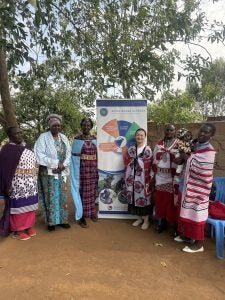
Michelle Liu with members of the Rural Women Network in Kajiado
The legal research and drafting of the amicus submission will be led by HRI Deputy Director and Adjunct Professor Michelle Liu, who has taught, litigated, and published extensively on women’s and children’s human rights in sub-Saharan Africa.
“Climate change disproportionately affects children and youth, women and girls, Indigenous people, and other marginalized communities,” said Professor Liu. “Our submission will seek to inform the Court’s analysis of international and regional human rights law as it relates to the rights to life, health, education, safety, and dignity in the context of the climate crisis in Africa, with particular attention to children and youth.”
The amicus brief to the African Court on Human and Peoples’ Rights forms part of HRI’s broader strategic litigation and advocacy efforts through this year’s Human Rights Advocacy in Action Practicum. In partnership with Our Children’s Trust, the practicum is focusing on the human rights of children in the United States and Africa in the context of the climate crisis. To complement their legal and factual research, three student teams—led by Professor Liu, Dash-Muse Teaching Fellow Melody Vidmar, and Professor Awista Ayazi—will conduct field investigations in the United States and Kenya. The teams will interview and consult with affected communities, youth climate leaders, human rights advocates, community organizers, lawmakers, and subject-matter experts. The Kenya field investigation will ensure that HRI’s forthcoming submission reflects the lived experiences of communities most directly impacted by climate change across the continent.
Background
Across Africa, individuals, families, and communities are confronting climate shocks of unprecedented scale and intensity. Extreme heat, catastrophic flooding, and prolonged droughts pose growing threats to health, safety, education, and livelihoods—particularly for children, who comprise nearly 45 percent of the continent’s population. Although Africa has contributed relatively little to global greenhouse gas emissions, it faces disproportionate climate harms driven largely by decades of high emissions from countries in the Global North.
Building on landmark advisory opinions issued by the International Court of Justice, the Inter-American Court of Human Rights, and the International Tribunal for the Law of the Sea, the African Court’s forthcoming advisory opinion is expected to provide critical regional legal guidance for future litigation and advocacy on climate justice, corporate accountability, and just energy transitions. The request for an advisory opinion was submitted by the Pan African Lawyers Union in collaboration with the African Climate Platform, led by 2024–2025 Robert F. Drinan Chair in Human Rights Alfred Lahai Brownell, Sr.
Written by Kinga Ewa Nastal. Edited by Michelle X. Liu.