

Futures at Stake: Climate Change, Human Rights, and Youth Advocacy
In 2025, the International Court of Justice issued an advisory opinion recognizing what communities on the frontlines of climate change have long known: “The protection of the environment is a precondition for the enjoyment of human rights.”
As floods, fires, extreme heat, and rising seas actively reshape where people can safely live, work, and raise families, it has become clear that our futures are at stake. While recent advisory opinions from international legal bodies mark a significant evolution in international law, they also raise a critical question: how can these legal principles be made real for the communities already bearing the burden of climate inaction?
On March 31, 2026, at the Samuel Dash Conference on Human Rights, Indigenous and youth activists opened the conversation by describing how anthropogenic climate change has already transformed their communities, and how their experiences have fueled organizing and leadership rather than resignation. The conference then turned to the legal arena, highlighting efforts that have driven the issuance of recent landmark international advisory opinions and how they can be leveraged before national courts and legislatures for maximum impact. Finally, panelists confronted the obstacles to meaningful climate action in the United States, including corporate capture and climate disinformation, and asked how lawyers and advocates can translate recent momentum in international law into durable domestic reform through creative lawyering and advocacy.
Welcome and Opening Remarks
Welcome from Elisa Massimino, Visiting Professor and Executive Director, Human Rights Institute
Panel One Keynote by Delaney Reynolds—The Right to a Future
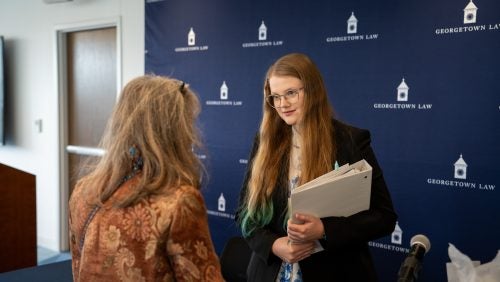
From melting glaciers and rising seas to bleaching coral reefs on the brink of functional extinction, climate activist Delaney Reynolds drew on her deep connection to South Florida’s coastlines and ecosystems to illustrate the urgent environmental stakes of the climate crisis. Tracing her journey from founding the Sink or Swim Project to championing solar power legislation in Florida, Reynolds made clear that environmental protection demands persistence across every available avenue: grassroots education, legislative advocacy, and the courts. Highlighting youth climate litigation victories in Montana, Hawaii, Colombia, and the Netherlands, she argued that the judiciary has become a powerful tool for holding governments accountable to their constitutional duty to protect both people and the planet.
Her closing message was one of shared environmental stewardship—the climate crisis will not be solved by any one person, but by a generation of young people who refuse to inherit a damaged earth without a fight. As Reynolds put it, “If a child can foster change and hope, imagine what we could do together!”
-
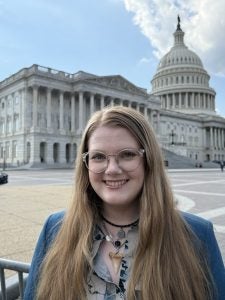
Youth Plaintiff, Lighthiser v. Trump and Reynolds v. Florida Public Service Commission, Ph.D. Candidate, University of Miami
Delaney Reynolds
Panel One—Activists at the Front Lines: Defending Our Right to a Livable Future
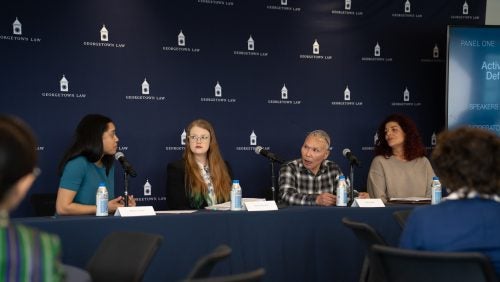
Frontline activists in the fight against climate change, Delaney Reynolds, Morris Alexie, and Brandy Bartholomew each arrived at the panel with evidence of what the crisis is already doing—rising seas pushing saltwater into Miami streets on clear, rainless days; permafrost that has held Alaskan homes in place for generations now thawing under warming temperatures; and hurricanes growing fierce enough to strip away the Louisiana wetlands that once stood between coastal villages and open water. Moderated by Maryum Jordan, the conversation moved between the deeply personal and the urgently political, weaving together stories of ecological loss, community displacement, and the growing gap between the scale of the crisis and the pace of government response. What connected all three voices was a shared refusal to treat climate change as an abstraction: for each of them, it is a daily reality that has already altered the landscapes, ecosystems, and ways of life they grew up knowing.
What emerged from the opening discussion was a portrait of resilience built not on institutions, but in spite of them. Reynolds has fought the climate crisis through the courts by participating in a series of constitutional lawsuits that, even when dismissed, have forced judges to acknowledge climate change as “an emergency against children and youth” and opened new avenues for advocacy at the state and municipal level. Bartholomew brought the perspective of the Grand Bayou Village in Louisiana, reminding the room that the communities absorbing the worst of the crisis are the same ones long denied a seat at the table: “if they would just understand where we are coming from as people on this planet, things would move forward.” Alexie, meanwhile, laid bare the existential challenges facing Indigenous Alaskans forced by circumstance to lead the very policy innovation and community-driven solutions that the federal government have been slow to provide, all while their homes literally sink beneath them. Together, they made the case that defending the right to a livable future is not a matter of waiting for political will to catch up, but of listening to, resourcing, and standing alongside the people who are already fighting for it.
-
Youth Plaintiff, Lighthiser v. Trump and Reynolds v. Florida Public Service Commission, Ph.D. Candidate, University of Miami
Delaney Reynolds
-
Member of Grand Bayou Village
Brandy Bartholomew
-

Community Engagement Specialist at Woodwell Climate Research Center, former Tribal Administrator for the Native Village of Nunapicuaq (Nunapitchuk)
Morris Alexie
-

Intergenerational Equity and the Rights of Future Generations: A Conversation with Edith Brown Weiss
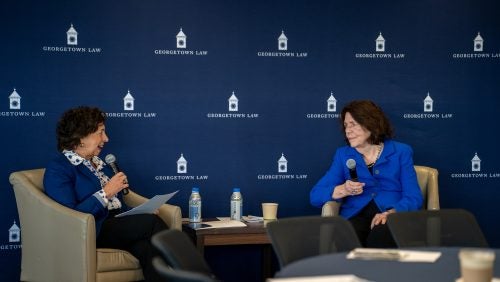
In a fireside chat moderated by HRI Executive Director Elisa Massimino, legal scholar Edith Brown Weiss outlined the impact of the concept of intergenerational equity in reshaping how courts, constitutions, and international bodies think about our obligations to those not yet born. At its core, intergenerational equity reflects the idea that humanity is embedded in a natural system that connects past, present, and future generations, and that we bear a collective responsibility to conserve the quality of, and access to, that system for those who come after us. Far from remaining an academic abstraction, the principle has quietly permeated the global legal landscape since the 1980s, surfacing in the UN Charter, the Rio Declaration, and the World Heritage Convention, and finding its way into the rulings of courts from the Philippines, where the Supreme Court’s landmark decision in Oposa v. Factoran recognized children’s standing to sue on behalf of future generations, to South Korea, where the Constitutional Court has acknowledged the climate rights of generations yet to come.
Weiss was careful to note that intergenerational and intragenerational equity are not competing values but deeply interconnected ones: the better current generations fare, particularly the most impoverished and vulnerable communities who have contributed least to the climate crisis, the stronger the foundation we leave for those who follow. Her central provocation to the room was that decision-making at every level is far too anchored in the present, and that whoever holds power must build in a forward-looking consideration for the future: “we need to think broadly on how to incorporate future generations into decision-making at all levels.”

Panel Two—Building the Legal Architecture for Climate Justice
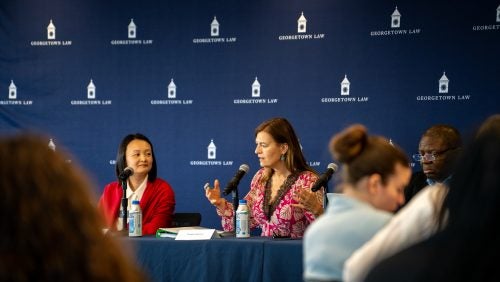
As the climate crisis intensifies, international law is increasingly being used to protect fundamental human rights. In recent years, the International Court of Justice, the Inter-American Court of Human Rights, and the International Tribunal for the Law of the Sea have issued major advisory opinions affirming that governments have binding legal duties to prevent climate harm, that climate-related impacts can constitute human rights violations, and that high-emitting states and corporations bear special responsibility to support a just transition in developing countries—with the African Court on Human and Peoples’ Rights poised to add its own landmark opinion to this growing body of law. Moderated by HRI Deputy Director Michelle Liu, the panel brought together Alfred Brownell, Naima Taafaki-Fifita, and Viviana Krsticevic to explore how these decisions are collectively reshaping the legal landscape for climate justice, centering children and future generations as rights-holders, and integrating indigenous knowledge and lived experience into the architecture of climate governance. Far from abstract legal milestones, these opinions are active tools: persuasive authority in domestic and international litigation, a new baseline for diplomatic negotiations, and a clear standard against which states can be held accountable.
Each panelist brought a distinct vantage point to what is, at its core, a question of accountability. Taafaki-Fifita challenged the fatalistic framing of sea-level rise, insisting that the disproportionate burden borne by small island states like Tuvalu is a matter of legal responsibility and that imagination, as she put it, is “not separate from legal work… it is a precondition for it.” Krsticevic illuminated how the Inter-American Court’s participatory process—drawing on civil society, scientists, and youth advocates—produced an opinion that bridges the persistent gap between what courts declare and what governments actually do. Brownell, meanwhile, anchored the conversation in history, situating Africa’s push for its own advisory opinion within a longer legacy of colonial extraction and demanding that the Global North “clean up your mess.” Together, the panelists made clear that building the legal architecture for climate justice is as much about reimagining futures grounded in dignity and self-determination as it is about defining the duties of states.
-

Founding President of Global Climate Legal Defense, Founder of Green Advocates International, Lead Campaigner of African Climate Platform and Environmental Rights Africa Initiative, 2019 Goldman Environmental Prize Winner (Liberia), and 2024–2025 Robert F. Drinan Chair in Human Rights
Alfred Brownell
-

Founder of the Moana Tasi Project and Senior Associate of Ocean Guardianship at Ocean Vision Legal
Naima Taafaki-Fifita
-
-
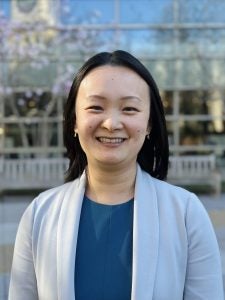
Deputy Director, Human Rights Institute and Adjunct Professor, Georgetown Law
Michelle Liu (moderator)
Panel Three—Creative Climate Action in the United States
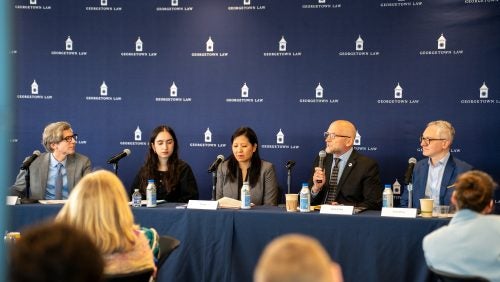
In the global discourse on anthropogenic climate change, no major country seriously disputes its existence except one—the United States. Under the guise of “energy security,” the executive branch has eviscerated environmental regulations and doubled down on fossil fuels, defying technological advances, economic and common sense, and international law to the peril of its own and the world’s future. And yet, as federal climate ambition stalls and the political landscape grows increasingly hostile to environmental protection, advocates, litigators, and young people are finding new and creative pathways to demand accountability. Moderated by Professor Mark Rupp, the panel brought together James May, Liz Lee, Layla Hasanzadah, and Scott Gilmore to explore the frontiers of rights-based climate action in the United States: from subnational constitutional provisions and public trust doctrine to corporate antitrust liability and international human rights bodies. What emerged was a portrait of a legal movement building its architecture one precedent at a time, grounded in the conviction that constitutional change, as Lee put it, “happens on a long arc.”
Each panelist illuminated a distinct dimension of that architecture. May mapped the underexplored terrain of subnational climate rights, arguing that state constitutions offer some of the most promising avenues for rights-based climate claims, especially as international advisory opinions begin to filter into domestic jurisprudence. Lee traced how Our Children’s Trust has reframed climate litigation around the fundamental rights of children, pointing to the landmark settlement in Navahine v. Hawaii where youth plaintiffs were able to negotiate successfully for the decarbonization of Hawaii’s transportation sector. Hasanzadah brought the human weight of that work to the surface, recounting her experience as lead plaintiff in Layla H. v. Commonwealth of Virginia—a case ultimately dismissed, but one that gave her, in her own words, a sense of agency she had never felt before, and that has since channeled her climate anxiety into mentorship and continued advocacy. Gilmore widened the lens to corporate accountability, tracing the evolution of tort and antitrust strategies and highlighting the growing wave of state-led litigation targeting the fossil fuel industry’s decades-long campaign to suppress clean energy alternatives and deceive the public. Together, the panelists made clear that climate justice efforts in the United States demand as much invention as endurance, that the work is less about winning any single case than about building the legal frameworks and mobilizing concerted action to outlast any political moment.
-

Richard S. Righter Distinguished Professor of Law and co-Director of the Center for Resources, Environmental and Energy Law, Washburn University; Founder, Dignity Rights Advocates
James R. May
-

-

Former Lead Plaintiff, Layla H. v. Commonwealth of Virginia, Member of Our Children’s Trust’s Youth Advisory Council and Climate Rights Corps
Layla Hasanzadah
-

-
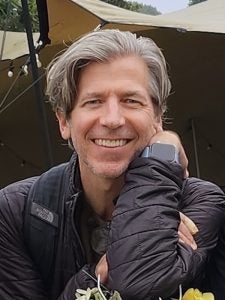
Director of External Relations at the Earth Commons, Georgetown University and Adjunct Professor, Georgetown University Law Center
Mark Rupp (moderator)