

Futures at Stake: Climate Change, Human Rights, and Youth Advocacy
In 2025, the International Court of Justice issued an advisory opinion recognizing what communities on the frontlines of climate change have long known: “The protection of the environment is a precondition for the enjoyment of human rights.”
As floods, fires, extreme heat, and rising seas actively reshape where people can safely live, work, and raise families, it has become clear that our futures are at stake. While recent advisory opinions from international legal bodies mark a significant evolution in international law, they also raise a critical question: how can these legal principles be made real for the communities already bearing the burden of climate inaction?
On March 31, 2026, at the Samuel Dash Conference on Human Rights, Indigenous and youth activists will open the conversation by describing how anthropogenic climate change has already transformed their communities, and how their experiences have fueled organizing and leadership rather than resignation. The conference will then turn to the legal arena, highlighting efforts that have driven the issuance of recent landmark international advisory opinions and how they can be leveraged before national courts and legislatures for maximum impact. Finally, panelists will confront the obstacles to meaningful climate action in the United States, including corporate capture and climate disinformation, and ask how lawyers and advocates can translate recent momentum in international law into durable domestic reform through creative lawyering and advocacy.
Welcome and Opening Remarks
Welcome from Elisa Massimino, Visiting Professor and Executive Director, Human Rights Institute
Panel One Keynote by Delaney Reynolds—The Right to a Future
From sinking islands of the South Pacific to small towns in the United States, young people around the world are demanding urgent action from governments and other powerful actors to address existential climate threats. Their activism is a call to conscience and a reminder that the struggle for climate justice is a struggle for human dignity, intergenerational equity, and the future of humanity.
-
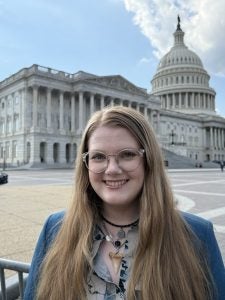
Youth Plaintiff, Lighthiser v. Trump and Reynolds v. Florida Public Service Commission, Ph.D. Candidate, University of Miami
Delaney Reynolds
Panel One—Activists at the Front Lines: Defending Our Right to a Livable Future
This opening panel will feature frontline activists, human rights defenders, and youth and Indigenous climate leaders who are united by the common goal of defending the right to a livable future. Panelists will share firsthand accounts of how climate change is already impacting their homes, communities, and daily lives. This moderated discussion aims to ground global climate trends and scientific data in personal narratives and lived experiences.
At the same time, the discussion emphasizes agency, resilience, and hope. Panelists will highlight how community engagement and collective action are generating meaningful change, even in the face of systemic challenges. This conversation will also feature Indigenous voices on the climate crisis and emphasize the importance of centering Indigenous perspectives in law and policy. Youth panelists will reflect on the growing centrality of young people within the environmental justice movement, what it means to come of age during this existential climate crisis, and how youth leadership is redefining advocacy and accountability.
-
Youth Plaintiff, Lighthiser v. Trump and Reynolds v. Florida Public Service Commission, Ph.D. Candidate, University of Miami
Delaney Reynolds
-
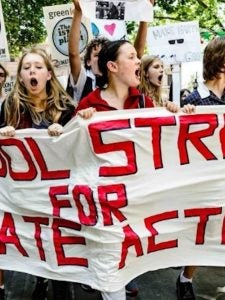
Member of Grand Bayou Village
Brandy Bartholomew
-

Community Engagement Specialist at Woodwell Climate Research Center, former Tribal Administrator for the Native Village of Nunapicuaq (Nunapitchuk)
Morris Alexie
-

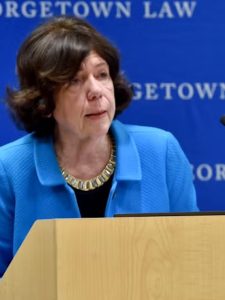
Intergenerational Equity and the Rights of Future Generations: A Conversation with Edith Brown Weiss

Panel Two—Building the Legal Architecture for Climate Justice
As the climate crisis intensifies, international law is increasingly being used to protect fundamental human rights. In recent years, the International Court of Justice, the Inter-American Court of Human Rights, and the International Tribunal for the Law of the Sea have issued major advisory opinions that are shaping how courts and governments around the world understand states’ responsibilities in the context of climate change. The African Court on Human and Peoples’ Rights will also issue an advisory opinion on states’ obligations to address the climate crisis. These decisions affirm that governments have legal duties under international law, recognize that climate-related harms can violate human rights, and emphasize the responsibility of high-emitting states and corporations to support a just transition in developing countries.
In this panel, legal advocates and experts will break down what these opinions say, why they matter, and how this emerging legal framework can support efforts to advance climate justice through national courts and legislative action worldwide.
-

Founding President of Global Climate Legal Defense, Founder of Green Advocates International, Lead Campaigner of African Climate Platform and Environmental Rights Africa Initiative, 2019 Goldman Environmental Prize Winner (Liberia), and 2024–2025 Robert F. Drinan Chair in Human Rights
Alfred Brownell
-

Founder of the Moana Tasi Project and Senior Associate of Ocean Guardianship at Ocean Vision Legal
Naima Taafaki-Fifita
-

-
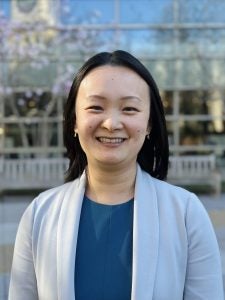
Deputy Director, Human Rights Institute and Adjunct Professor, Georgetown Law
Michelle Liu (moderator)
Panel Three—Creative Climate Action in the United States
In the global discourse on anthropogenic climate change, no major country seriously disputes its existence except one—the United States. Under the guise of “energy security,” the executive branch has eviscerated environmental regulations and doubled down on fossil fuels. As the second highest emitter of greenhouse gasses globally—and on track to increase emissions—the United States is defying technological advances, economic sense, and international law to the peril of its and the world’s future.
This closing panel will confront the obstacles to meaningful climate action in the United States and explore pathways forward. Panelists will consider these questions: What is the role of sub- and supra-national bodies? How can we safeguard the integrity of climate science, expert data, and journalism to challenge mis- and dis-information about climate change and energy policy? How do we combat corporate capture by the fossil fuel industry of our democratic and political processes? How can lawyers leverage evolving human rights norms and guarantees, and the international advisory opinions affirming them, in domestic rights-based litigation? And what role can civil society—particularly activists, organizers, students, and citizens—play to bring global concern for our shared future into our mainstream consciousness?
-

Richard S. Righter Distinguished Professor of Law and co-Director of the Center for Resources, Environmental and Energy Law, Washburn University; Founder, Dignity Rights Advocates
James R. May
-

-

Former Lead Plaintiff, Layla H. v. Commonwealth of Virginia, Member of Our Children’s Trust’s Youth Advisory Council and Climate Rights Corps
Layla Hasanzadah
-

-
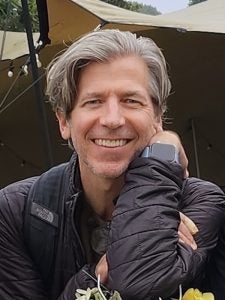
Director of External Relations at the Earth Commons, Georgetown University and Adjunct Professor, Georgetown University Law Center
Mark Rupp (moderator)