Orientation 2024: 1,000+ New ‘Hoya Lawyas’ Begin Their Georgetown Law Journey
August 29, 2024
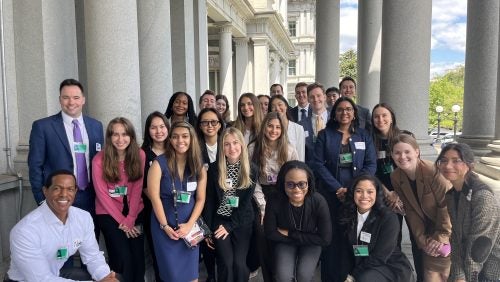
New students visited the White House for a behind-the-scenes tour of the Office of the National Cyber Director.
The best part of law school orientation?
For Alex Michie, L’27, of Zionsville, Ind., it was as simple as waiting for the bus, where he met new classmates who were also headed across town to Georgetown University’s Hilltop campus for the annual Faculty Moot Court. “Strangely enough, that was my favorite part of the week,” he said. “Those were the first real connections I made.”
Forging new connections was at the core of this year’s orientation activities, which began Monday, August 19 for graduate programs and Tuesday, August 20 for the J.D. program. Whether gathering in classrooms or on the Eleanor Holmes Norton Green, students swarmed campus for a busy week of events and activities that included information sessions, mock classes, behind-the-scenes tours, neighborhood excursions and more.
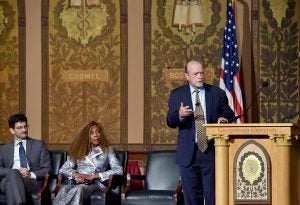
L-R: Dean of Students Mitch Bailin, Georgetown University Vice President for Institutional Diversity and Equity Rosemary Kilkenny, L’87, and Dean William M. Treanor welcomed students at the 2024 Faculty Moot Court.
“You are in a group of extraordinary people,” Dean William M. Treanor told the new students during his welcome address at the Faculty Moot, underscoring that this admissions cycle was historically competitive, with 658 new J.D. students joining Georgetown Law from among 11,296 applicants. Treanor likened the incoming class to an orchestra strengthened by the diversity of its instruments — in this case, students who exemplify “different perspectives, different life stories and different approaches to the law.”
The entering class is not only the Law Center’s largest ever, but also among its most accomplished: Incoming students have a record-high median college GPA of 3.92 and a record-tying median LSAT score of 171. Of the incoming J.D. class, 58% are women and 9% are first-generation college students. The class is also geographically diverse, with new students hailing from 47 states and, including the nearly 500 LL.M. and graduate students joining the Law Center this fall, representing 73 different countries.
Learning in the nation’s capital
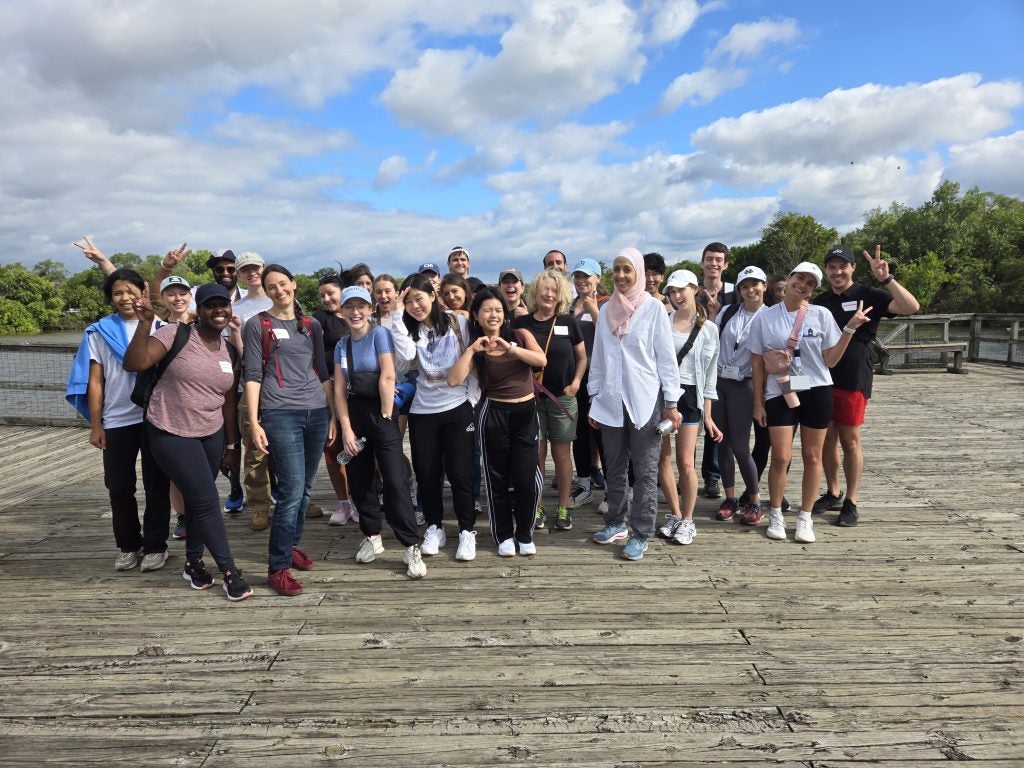
During an Anacostia Riverwalk hike, students learned about opportunities to explore environmental law on campus.
Orientation week kicked off with a series of city tours highlighting sites of interest near campus, including a morning jog along the National Mall; a sightseeing tour of historic Capitol Hill neighborhoods; an Anacostia Riverwalk hike with members of the environmental law faculty; a question-and-answer session at the Organization of American States led by the Human Rights Institute; and a visit to the nearby Capital Jewish Museum with Jewish Chaplain Michael Goldman, L’69.
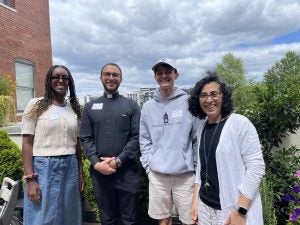
Mike Lamanna (second from left), S.J., L’25, led a tour of sites embodying Georgetown’s Ignatian values and Jesuit history, including the St. Thomas More Chapel and nearby Father McKenna Center for those experiencing housing and food insecurity.
New tour offerings this year included a Capitol Campus Jesuit walking tour led by Jesuit priest and current 3L Mike Lamanna, S.J., L’25, and an exclusive White House tour of the Office of the National Cyber Director led by the Institute for Technology Law & Policy.
“The fact that my dad runs a food truck in New York City, and I’m about to learn about cybersecurity inside of the White House is one of the coolest things — especially given that I haven’t started class yet,” said Amy Abdalla, L’27, of the chance to get a behind-the-scenes look at the work of the nation’s top cyber experts.
LL.M. student Rana AlTurki, L’26, who is pursuing a graduate degree to advance her work as a legal specialist in Saudi Arabia, expressed similar excitement about the Law Center’s location in Washington, D.C. “It’s like the Dean said: Georgetown is the best,” she said, adding that she’s particularly excited to continue her legal studies near the White House and Library of Congress.
Thinking like lawyers
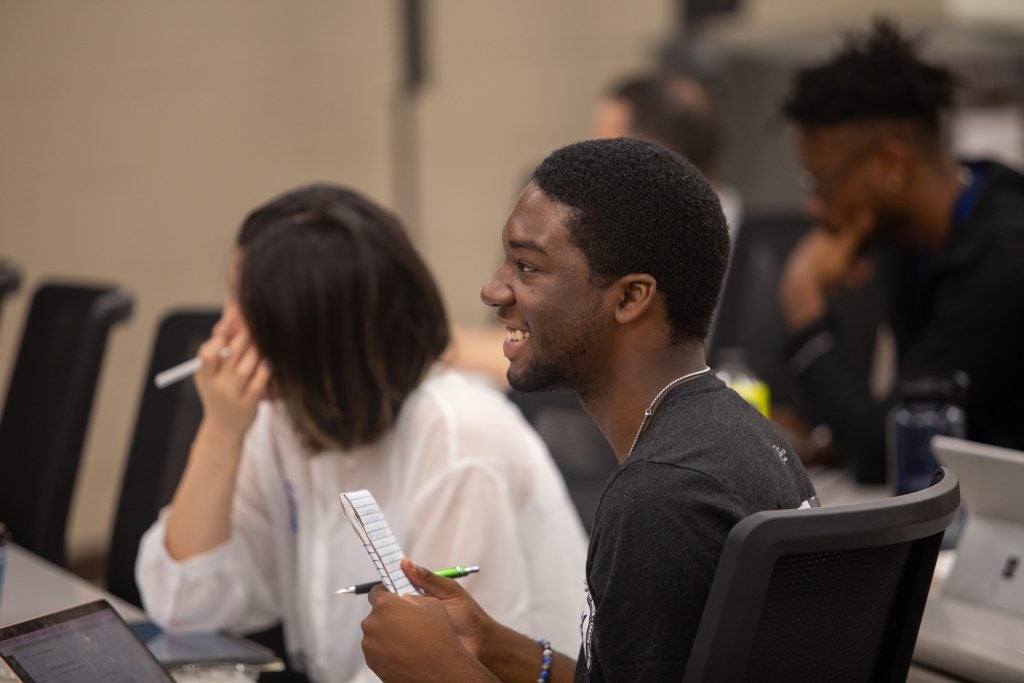
Mock class sessions offered the chance to meet professors and preview the classroom experience.
The learning continued in the classroom, where students were introduced to the basics of legal reasoning (and survived their first cold calls) during section-specific “Introduction to the First-Year Classroom” sessions, which began with an hour of faculty instruction and ended with a discussion about what to expect from 1L courses, including advice for how to start studying — and thinking — like lawyers.
For Maeve Breathnach, L’27, who most recently studied refugee integration as a Fulbright Scholar in Ireland, the experience provided a much-appreciated confidence boost. “The mock class calmed my nerves and showed me what I can expect out of the law school learning environment,” she said, emphasizing that she is eager to study the historical and social underpinnings of law as part of Curriculum B (Section 3), Georgetown’s Law alternative 1L curriculum.
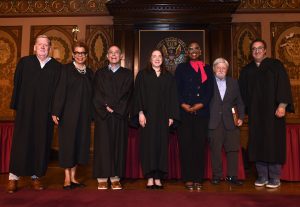
L-R: Profs. Paul Smith, Sheryll Cashin, Irv Gornstein, Erica Hashimoto, Michele Goodwin, Michael Gottesman and Martin Lederman participated in this year’s Faculty Moot.
Students also had the chance to witness formidable lawyering in person at the annual Faculty Moot Court held on Thursday, August 22. Professor Michele Goodwin represented the petitioner and Professor Michael Gottesman played the role of the respondent in United States v. Skrmetti, a case concerning gender-affirming healthcare for transgender minors that will be heard by the U.S. Supreme Court this fall. Goodwin and Gottesman delivered opening statements and faced tough questioning from a panel of “justices” that included Professors Paul Smith, Sheryll Cashin, Erica Hashimoto, Martin Lederman and Irv Gornstein, executive director of the Supreme Court Institute.
“It was great to see the professors in action, not just as teachers in the classroom, but as practitioners,” reflected Jason Sutton, L’28, who attended the moot with fellow students from Georgetown Law’s Evening Program. Sutton, a Navy pilot, is among the 68 students entering as evening students this year — the program’s largest-ever cohort.
“The biggest highlight has been getting to see law in practice,” echoed Bhavana Kunnath, L’27, of Lawrenceville, Ga. “It’s one thing to watch lawyer TV shows, but it’s another thing to see it play out in real life. You feel the pieces coming together in your head,” she said, noting that as someone interested in immigration law, watching the moot made her more interested in pursuing oral advocacy in the future.
RISE Pre-Orientation 2024
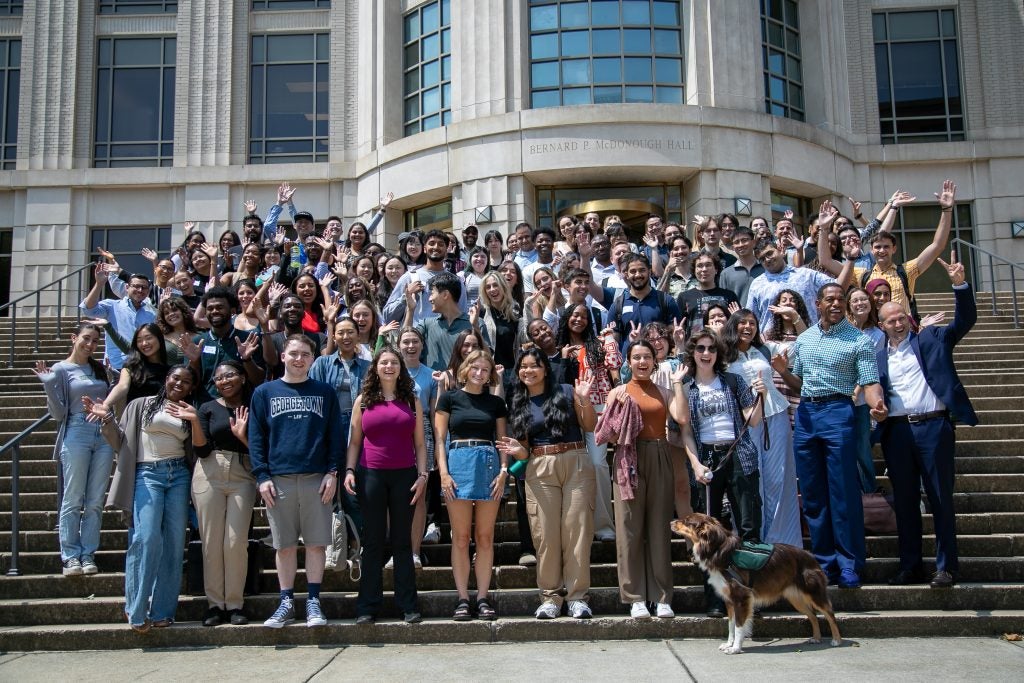
Incoming RISE Fellows gathered for a group photo on the McDonough Hall steps.
110 J.D. students also participated in a pre-orientation week organized by RISE, the Law Center’s program for students who may have had less exposure to the legal profession before applying to law school. The schedule included mock classes and exams, a welcome reception and group dinner and information sessions on topics such as career planning, financial aid and library resources.
RISE fellows got acclimated to campus during mock classes (pictured above) and other pre-orientation activities.
“RISE was the perfect way to get acclimated to the new academic environment” said Eyram Gbeddy, L’27, a RISE fellow whose Pennsylvania upbringing galvanized an interest in electoral politics and government work. Gbeddy particularly appreciated the pre-orientation mock class and exam, which provided a “wonderful sample” of academic expectations in law school.
For RISE fellow Malaaz Ghandour, L’27, pre-orientation also provided a helpful glimpse of life after graduation. Her favorite activity was an information session covering the career paths available to law graduates. “It can be overwhelming to decipher the professions within the legal world,” she said. “The session made me realize that I am not limited to a certain path and have flexibility regarding my career in the future.”
The pre-orientation week also offered the chance for the RISE fellows to get to know one another. “It was nice to meet and interact with other students days in advance so that I didn’t arrive at law school alone,” said Harrison Gummel, L’27. “As a first-generation law student, I would highly recommend that any future 1Ls take advantage of the program to gain a better idea about what law school entails.”
Many voices, one community

Classmates made new connections over coffee and bagels at Welcome Breakfasts held at the start of the week.
Throughout the week, students were not only introduced to a new, lawyerly way of thinking, but also encouraged to engage in constructive dialogue with classmates and professors — a skill applicable in the classroom and their professional lives.
Considering alternate viewpoints is “the core of lawyering,” said Professor and Associate Dean for Academic Affairs Urska Velikonja during a Section 5 welcome session. “Call it empathy, or call it legal skill, but you need to be able to understand the argument on the other side.”
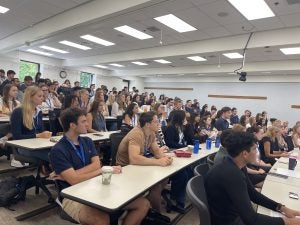
“Beyond the Briefs” panels brought together incoming and upper-level students for discussions about conflict management and dialogue across differences.
During “Beyond the Briefs: Respectful Dialogue as a Core Competency in Legal Practice,” a series of panel discussions organized by the Office of Equity & Inclusion (OEI), upper-level students with ties to a diverse array of campus student organizations and affinity groups offered candid advice about managing conflict and engaging in meaningful conversations about difficult topics.
“Stay open to connecting with anyone on this campus [and] figure out the things you have in common with your classmates,” urged panelist Lauren Eber, L’25, who encouraged the incoming students to find ways to manage stress during challenging periods, whether academic or personal.
For many students, finding commonalities with new classmates was the highlight of the week. “If there’s one thing orientation taught me, it’s that making friends who can help keep you grounded is critical in law school,” reflected Daniel Thompson, L’27, following a lively mock class in which he and his sectionmates debated the fundamentals of torts and contracts. “Orientation gave everyone the opportunity to do just that.”