LL.M. in National and Global Health Law
Supplement your legal training and develop your expertise in health law.
Georgetown Law offers an LL.M. in National and Global Health Law that allows students to develop expertise at the intersections of health and law, including in the areas of global health governance, infectious diseases and the law, noncommunicable diseases and the law, health and human rights, trade law and health, bioethics, food and drug law, and access to health care.
The Health Law Programs at Georgetown Law train lawyers to apply their specialized legal skills to improve public health in the United States and globally. The Health Law Programs comprise the LL.M. in National and Global Health Law, joint LL.M. in Global Health Law and Governance(This link opens in a new tab) with the Geneva Graduate Institute, Certificate in Food and Drug Law(This link opens in a new tab), and Certificate in U.S. Health Law(This link opens in a new tab).
Program Overview
Detailed program requirements for the LL.M. in National and Global Health Law program are listed below.
- Enrollment: Full-Time or Part-Time
- International students in F-1 or J-1 visa status must enroll full-time.
- Program Length: Students must complete all program requirements for the degree within:
- Full-Time: 1 Academic Year
- Part-Time: 3 Years
- Mode of Instruction: In-Person
- Total Required Credits:
- U.S.-Trained Students: 24 credits
- Foreign-Trained Students: 20 credits
- Specialization Credits: Students must complete the required specializations credits from curricular offerings related to health law. Refer to the Curriculum Guide to find the current list of offerings by selecting Health Law LL.M.
- U.S.-Trained Students: 16 credits
- Foreign-Trained Students: 14 credits
- Required Course: As part of the specialization credits, each student must successfully complete:
- Global Health Law (2 credits)
- Experiential Learning: With advanced approval from the LL.M. Program Director, students may count externship course credit towards the specialization credits.
- U.S.-Trained Students: Participation in an externship or practicum within the field is highly encouraged.
- Foreign-Trained Students: There is an option to enroll in the Practice-Oriented Degree Track. Students in the practice-oriented degree track must complete at least one off-campus experiential learning opportunity within the field, such as an externship or practicum, as a part of degree requirements. More information on Practice-Oriented Degree Tracks can be found in the Georgetown Law Student Handbook of Academic Policies.
- Grade Point Average (GPA): Students must earn a minimum cumulative GPA of at least 2.00.
The program requirements listed above should be used as a reference, and have been sourced from the Georgetown Law Student Handbook of Academic Policies. In the event of any inconsistency, the program requirements listed in the Student Handbook take precedence.
Coursework
Georgetown Law has an unparalleled health law curriculum, with more than 35 courses addressing domestic and global health law. Students work with their academic advisor to create their own specialized plan of study suited to their passions and career goals.
Georgetown’s innovative curricular offerings explore the intersections of health and law, including global health governance, infectious diseases and the law, noncommunicable diseases and the law, health and human rights, trade law and health, bioethics, food and drug law, and access to health care.
All LL.M. in National and Global Health Law candidates are enrolled in Global Health Law during their first semester, which explores the roles that the law, lawyers, and legal institutions play in public health across the globe.
Students can pursue a Certificate of Specialization in combination with the LL.M. in National and Global Health Law program. The Health Law Programs offer two health law related Certificates of Specialization: the Certificate in Food and Drug Law, Certificate in U.S. Health Law. A majority of credits needed to fulfill requirements for the health law related Certificates of Specialization will overlap as LL.M. in National and Global Health Law specialization credits.
Refer to the Georgetown Law Curriculum Guide and select Health Law LL.M. for a complete list of curricular offerings in health law. To view course descriptions of current and previous course offerings, visit the National and Global Health Law Curriculum Essay.
Foreign-trained students who wish to fulfill course requirements for New York Bar eligibility have the ability to do so while pursuing their LL.M. program. However, this requires careful planning and course selection. Students should speak with the LL.M. Program Director for further guidance.
Faculty
Georgetown Law’s health law courses are taught by a diverse faculty of academics, subject matter experts, and practitioners from government, international organizations, and private practice.
Visit the Georgetown Law Faculty Directory to view full-time professor profiles, and the O’Neill Institute Faculty page to view the full list of professors who teach courses in the Health Law Programs.
Alternatively, to view the professor bio of a particular course, select a course from the Curriculum Guide and scroll to the Professors section of the course information page.
Campus Life
Georgetown Law offers a rich array of student organizations and activities that allow students to find their own path at law school. With over 85+ registered student organizations, available programming and activities span across a broad range of legal disciplines, provide support and activities for ethnic, religious and other identity groups, promote social justice causes and host social gatherings. The diverse selection of student groups provides an abundance of opportunities to hone leadership and lawyering skills, make new friends, expand professional opportunities, and make a difference in Washington, D.C. and the world.
One student-run organization that may be of interest to LL.M. in National and Global Health Law students is the Health Law Society. To learn more about how to get more involved in Georgetown Law student life, visit the Activities & Organizations page.
Students interested in writing, reviewing and publishing scholarly articles on legal issues may consider participating in one of Georgetown’s law journals.
Georgetown Law is home to 20+ centers and institutes, each having their own hub of expertise, from public health and international economics, to human rights and technology. Students can engage with professors outside of the classroom, and collaborate with center and institute staff who are leaders in their respective fields.
Students in the Health Law Programs engage closely with the O’Neill Institute for National and Global Health Law during their time at Georgetown Law. As a home base for students studying health law, the O’Neill Institute has many opportunities and programming to to take advantage of, such as attending symposia and events, participating in career and professional development programs, and taking part in a mentorship program that partners students with O’Neill Institute staff and program alumni.
To learn more about the research initiatives of each center and institute, visit the Georgetown Law Centers & Institutes website.
- O’Neill Institute for National and Global Health Law
- Center for Global Health Policy & Politics
- Center on Gender Justice & Opportunity
- Center on Inclusive Trade and Development
- Center on Poverty and Inequality
- Harrison Institute for Public Law
- Health Justice Alliance
- Human Rights Institute
- Other Centers & Institutes
Experiential Learning
Study in the Health Law Programs offer a unique combination of rigorous academic study and practical learning opportunities. Students are eligible to apply for opportunities to work as part-time research assistants supporting projects at the O’Neill Institute for National and Global Health Law, a premier research institution working at the intersection of health and the law. Experts from the Institute work on critical health law issues globally including but not limited to, global health governance, addiction and mental health, infectious diseases, and sexual and reproductive health rights. Students can develop real world work experience, network with O’Neill experts, and contribute to ongoing health advancing health equity in the United States and around the world.
Additionally, there are many opportunities for students to consider off-campus externships and practicums in Washington, DC, from private firms and healthcare companies to government agencies, non-governmental organizations, and international organizations. Externships related to health and human rights, food and drug law, health care access and international development give students the opportunity to undertake real-world projects under the supervision of a practicing attorney.
For more information regarding externships and practicums, please visit the LL.M. Externships and Practicums pages.
Additionally, Georgetown Law students have numerous opportunities to engage in pro bono and community service during their studies and after graduation to provide assistance to those in need.
Career Resources
The Office of Graduate Careers is among the few law school career centers in the United States catered to LL.M. students, both during school and after graduation, to help students be proactive, organized and diligent in their employment search.
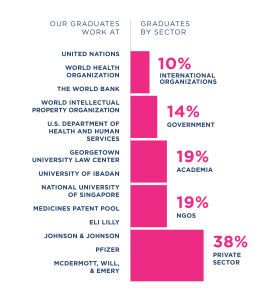
Our deeply knowledgeable career advisors, O’Neill Institute for National and Global Health Law experts, and extensive network of alumni and faculty open doors to a plethora of opportunities. We have more than 200 graduates from 30 countries working to improve the public’s health in the private sector, academia, non-government organizations, international organizations, and all levels of government.
Foreign-trained students have the opportunity to partake in the International Student Interview Program (ISIP). ISIP is an annual consortium event sponsored by 30+ law schools, including Georgetown University Law Center, and hosted by NYU School of Law to facilitate the hiring of highly qualified foreign-trained students enrolled in LL.M. programs at each school. ISIP attracts more than 140 of the leading legal employers from around the world, who review student resumes based on their hiring needs and country of practice.
To find more information and resources on professional development, career advancement, recruitment programs, and job search opportunities, visit the Office of Graduate Careers and Practice Areas section of the Career Exploration & Professional Development page.
- Office of Graduate Careers
- International Student Interview Program
- O’Neill Institute: Health Law Programs Alumni
- O’Neill Institute: Post-Graduate Fellowship
- LL.M. Post-Graduate Fellowship
- Explore Legal Careers
- Explore Legal Careers: Health Law
- Explore Legal Careers: International Development
- Explore Legal Careers: International Human Rights
Related Programs
Georgetown J.D. candidates can obtain an LL.M. in National and Global Health Law degree by completing 12 additional credit hours, through the joint J.D./LL.M. in National and Global Health Law.
The joint LL.M. in Global Health Law and Governance is a one-year intensive full-time LL.M. program, in which students spend the fall semester at Georgetown Law in Washington D.C., the spring semester at the Geneva Graduate Institute, and the summer participating in a full-time internship or dissertation in Geneva, Switzerland. This joint degree program is a unique opportunity for students to specialize in a rapidly evolving law and policy-making field and study at two renowned institutions at the forefront of global health governance.
LL.M. in National and Global Health Law candidates are eligible to pair their degree studies with a Certificate of Specialization, particularly the Certificate in Food and Drug Law and Certificate in U.S. Health Law. A majority of credits needed to fulfill requirements for the health law related Certificates of Specialization will overlap as LL.M. in National and Global Health Law specialization credits. If interested in pursuing this combination, students should speak with the LL.M. Program Director for academic advising.
Foreign-trained students have the opportunity to get a head start to their studies at Georgetown Law and experience in Washington, DC by attending the LL.M. Summer Experience. The LL.M. Summer Experience is a 6 week pre-program that allows students to earn up to 4 additional credit hours before the start of their degree studies that can be used towards LL.M. program requirements and New York Bar eligibility. All courses in Session I and Session II are approved by the New York Bar and allow more flexibility in course selection during the fall and spring semesters.
Scholarships, Fellowships and Financial Aid
Georgetown Law awards a small number of partial merit based scholarships to LL.M. degree applicants. Scholarships are awarded on the basis of their LL.M. degree application on a rolling basis.
The O’Neill Institute for National and Global Health Law offers various scholarships to applicants who demonstrate a strong interest or potential for excellence within the field of health law. Awards range from partial to full tuition scholarships. Health law scholarships include Global Health Law Scholars, Belén Ríos Health and Human Rights Scholarship, and Healthy Food Law and Policy Scholarship.
The John H. Jackson Moot Scholarship, is a half tuition scholarship awarded to up to two candidates applying to any full-time in-person specialized LL.M. degree program who were previously a student or coach of a university team participating in the John H. Jackson Moot Court Competition (previously known as the ELSA WTO Moot Court Competition) and advanced to the final rounds in Geneva, Switzerland.
The Leadership and Advocacy for Women in Africa (LAWA) Fellowship Program is an intensive and rigorous fellowship offered to women’s human rights lawyers from Africa applying to a Georgetown LL.M. program who are committed to advancing the status of women and girls in their home country as part of their career. The fellowship covers the full cost of tuition, health insurance, and textbooks. Visit the Women’s Law & Public Policy Program website for more information and application details.
Applicants who are U.S. citizens or legal permanent residents may apply for financial aid in the form of loans. For more information please visit the Georgetown Law Financial Aid website.