

Andrea Prasow (L’03): A Career Dedicated to Freeing the Unlawfully Detained
Andrea Prasow (L’03), Executive Director of Freedom Now, has dedicated her career in human rights to representing and advocating for prisoners of conscience worldwide.
Even as a kid, Andrea remembers being adamant that everyone deserved the right to a free trial. Today, as Executive Director of Freedom Now, Prasow leads an NGO that represents prisoners of conscience around the world. “We’re a lawyers’ NGO,” she says. “The root of what we do is legal support and campaigning. We work to get people out of prison who never should have been there.”
In 2001, Freedom Now was founded to protect individuals and communities from government repression. Since its founding, Freedom Now has provided pro bono legal representation to nearly 200 prisoners of conscience around the world. In addition to direct legal support, the organization also operates domestic and international advocacy and policy levers—they bring congressional attention and publicity to certain cases by getting them nominated for the Defending Freedoms Project, a project of the Tom Lantos Commission for Human Rights in Congress, file petitions before the United Nations Working Group on Arbitrary Detention for their clients, and work to secure Urgency Resolutions from the European Parliament. 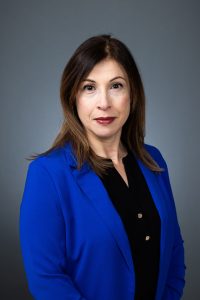
Often, the advocacy aspect of Freedom Now’s mission is just as important as the direct legal representation they offer. “In general, publicity helps. Even if it doesn’t get people out, though it usually does, it helps keep people alive because they are less likely to be tortured and killed in detention when a member of Congress has said their name out loud.” Not only does congressional attention and publicity buy prisoners of conscience and their representatives time, but it is also incredibly important to the individuals in detention. “Very often, people in political detention are denied access to their family and are told that nobody cares about them. When they hear there is a public campaign for their release, it is deeply meaningful.”
From Studying at Georgetown Law to Practicing at Guantanamo Bay
When Andrea started at Georgetown Law, she imagined a future in reproductive rights. But her trajectory shifted after September 11. In January 2002, Andrea was sitting in an International Human Rights Law seminar in McDonough Hall when the first photographs of detainees arriving at Guantánamo Bay came out. She saw the men in orange jumpsuits, hooded and shackled. Ultimately, Andrea went on to represent the men detained at Guantánamo while practicing at her first job after graduation.
Andrea speaks fondly of her time at Georgetown Law and the environment that encouraged and prepared her to pursue a career in international human rights, even when she ultimately chose to start her career at a firm. “Georgetown is one of the few top law schools where pursuing public interest isn’t treated as a fallback,” she says. “It’s seen as a real, viable path.”
When asked what skills are most important to her work, Andrea answered: “Listening, because we serve clients and must ensure what we do is meaningful to them. And creativity, because this is really hard work and there are no easy answers.” Andrea’s experiences in the International Women’s Human Rights Clinic, Jessup Moot Court, and the Gilbert and Sullivan Society in particular, taught her the importance of these skills in lawyering early on in her career.
To current Georgetown Law students seeking a career in human rights law, Andrea emphasizes how much the human rights community values the next generation. “People in this field want more people in this field. Cold email us. Ask for the informational interview. We don’t see it as doing you a favor—we see it as building our community.”
After graduation, she intentionally sought out a firm that allowed unlimited pro bono work and joined Paul Weiss. There, she became part of one of the first teams representing Guantánamo detainees. “Those were the first political prisoners I ever represented. People were put in Guantánamo explicitly because there was a belief they would be outside the law, outside the reach of the courts. As a lawyer, that felt like a thing I had to challenge.”
Her pro bono firm work led her to her next position at the Office of Military Commissions at the Department of Defense, where she served as a defense attorney for detainees charged in the military tribunal system. She worked on several cases, including that of Salim Hamdan, the only detainee to date to have a completed contested trial at Guantánamo. Later, at Human Rights Watch, she spent more than a decade leading research and advocacy on U.S. counterterrorism, national security, and human rights policy.
“Interviewing people for reports is important,” she says of her time at Human Rights Watch, “but you have to tell them, ‘I can’t do anything for you directly.’ Representing an individual is different. Knowing we are fighting for someone’s life and liberty—that is the most satisfying part of what I do.”
Using the System We Have: The Value of our International Legal System
In an era of democratic backsliding and domestic pessimism about human rights, Prasow remains clear-eyed about the value of the system we have. When people question whether international human rights mechanisms “work,” she thinks of her clients.
“A U.N. Working Group opinion doesn’t open the prison door,” she acknowledges. “But it matters. It matters to the person sitting in a cell. It matters to the government detaining them. And it tells the world: this detention is unlawful. Until we build a better system, I’m going to use the one we have.”
She also rejects the notion that global and domestic human rights work are separate spheres. At Freedom Now’s recent campaign during the COP 29 U.N. Climate Conference in Azerbaijan, she brought together human rights and climate activists to highlight the reality that Azerbaijan has detained upwards of 300 political prisoners. “It’s all interconnected. Supporting a political prisoner is supporting climate goals. We are stronger when we work together as a global community.”
Written by Edie Tepper, edited by Michelle Liu