

Mai El-Sadany (L’15): Applying Law, Advocacy, and Solidarity to Secure Just and Accountable Futures for the MENA Region
Mai El-Sadany (L’15), the Executive Director of the Tahrir Institute for Middle East Policy (TIMEP), is a human rights lawyer who, through litigation, policy advocacy, and coalition building on the ground, works to foster just and accountable futures for the MENA region.
At the beginning of our conversation, Mai framed TIMEP’s work in the important history that led to its founding. “It’s significant that we’re speaking today,” she reflected in a recent conversation, noting that December 17 marks the anniversary of Mohamed Bouazizi’s self-immolation in Tunisia, the act that sparked the Arab Uprisings in 2011. For Mai, that moment was formative. 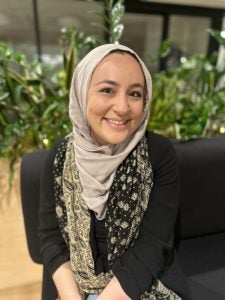 The uprisings “birthed a whole new generation of people… recommitting to values of freedom, social justice, and dignity.” TIMEP itself was born from that movement; its founders were on the ground in Tahrir Square in 2011. In 2013, they launched TIMEP with the mission to elevate the voices of advocates and experts from the region in policy conversations to ensure their perspectives are heard, their work is strengthened, and they are protected. This mission mirrors Mai’s personal and professional aspirations.
When she first joined TIMEP in 2018 as Legal and Judicial Director, she founded the organization’s first-ever legal unit. She wanted the unit to be an intentional effort to close the gap between law and policy efforts. She explained to me that “lawyers often don’t talk to policy advocates, and advocates don’t talk to lawyers, but being an advocate makes me a much better lawyer, and being a lawyer makes me a much better advocate.” It was this vision that inspired Mai to build a “hub within a hub,” where lawyers, legal advocates, victims and survivors could come together and use law as a tool for change in the MENA region.
Georgetown Law and Human Rights
Mai was born in Egypt and raised in the United States, so from a young age she felt a deep connection to the region. As she was preparing to graduate from college, the Arab Uprisings captivated her attention, confirming what she had known for a long time—she wanted her work to focus on the MENA region. She moved to Washington, D.C., to work at a leading think tank, and ultimately decided she wanted to attend law school.
She chose Georgetown Law because of its emphasis on international law and public interest. The Law Center’s proximity to policymakers in Washington, D.C. also appealed to her. While at Georgetown, she made the most of her 2L and 3L years, taking courses that focused her attention on human rights law. She joined the Human Rights Institute’s Human Rights Associates Program, the International Women’s Human Rights Clinic, and took classes with professors like Andrew Schoenholtz, whose practice and expertise aligned with her interests. HRAP taught Mai that there is not one, clear path to becoming a human rights lawyer. Her clinic introduced her to strategic litigation, international work, and coalition-building, as she was tasked with filing a complaint in Kenya’s Supreme Court challenging laws that upheld marital rape. Collaborating with partners—local human rights attorneys and experts—was critical to the success of the project. The importance of collaborating with local experts is a lesson that carries into her current work at TIMEP.
Solidarity, Community, and the Law
Before leading TIMEP, Mai had worked closely with families of detainees, including at Robert and Ethel Kennedy Human Rights Center as the first Dale and James J. Pinto Fellowship recipient. Early experiences as a Fellow, like listening to family members discuss the details of their loved ones’ detentions in Egypt, shaped her understanding of advocacy. “In the human rights space, if you’re representing someone, you need to be a human first,” she says. Listening, making families feel less alone, and honoring small wins along the way are just as important as securing release.
“Getting releases is hard,” she acknowledges. “But the days that we made a family feel less alone, that matters just as much. For them, it’s the world.”
The legal unit Mai established at TIMEP publishes research on justice and accountability, analyzes and tracks legislation such as Egypt’s protest law, convenes regional lawyers and civil society actors, and collaborates on cases before international mechanisms including U.N. Special Procedures, U.N. Working Groups, and regional bodies like the African Court on Human and Peoples’ Rights. In one recent project, TIMEP brought together people who have been impacted by crises in Lebanon with lawyers and journalists to talk about how they can work together more effectively. For another project, the team worked with Egyptian lawyers representing a transgender client in detention, helping incorporate international law arguments alongside domestic claims. The goal, Mai says, is to make international and regional law more accessible to lawyers and advocates inside the region. The legal team at TIMEP starts from scratch with every new issue they take on because the needs of impacted persons are different each time, and so is the political and legal situation on the ground in the jurisdiction.
Mai finds hope in the coalitions that form around the work, including families, journalists, artists, civil society organizations, and international actors coming together in creative solidarity. “Such a diverse, intersectional community came together,” she recalls of one campaign that led to the eventual release of Egyptian writer and activist, Alaa Abd El Fattah. “Not just people who cared about Egypt, but people who cared about freedom from all around the world and from across all backgrounds and sectors.”
For Mai, the legacy of the Arab Uprisings is ongoing. Through law, policy, advocacy, and solidarity, at TIMEP she continues to pursue the same aspirations voiced in Tahrir Square.