

Melysa Sperber (L’04): Strengthening Democracy through Supporting International Workers’ Rights at the Solidarity Center
As Policy Director at the Solidarity Center, an international labor rights organization operating in more than 60 countries, Melysa Sperber’s role is to advocate for the funding and policies that sustain worker-led movements around the world.
The Solidarity Center is one of the four core institutes of the National Endowment for Democracy, meaning in addition to the appropriations and foreign policy work of the organization, Melysa is focused on democracy, rights, and governance from a workers’ rights lens. In recent years, that work has become more urgent as shifting political priorities have reshaped the landscape for democracy and labor rights programming.
Melysa explains that her job at the Solidarity Center is to confront these shifting political priorities. “In my role, I need to make sure Congress is appropriating funds that support programs that cover this kind of work,” she says.
The programs Melysa is referring to range from supporting union organizing and collective bargaining efforts to providing legal assistance through global networks of labor lawyers. 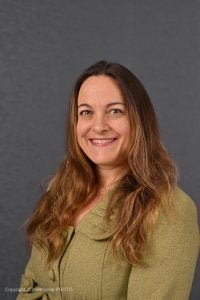 The Solidarity Center’s work aims to empower workers to advocate for themselves. In countries like Bangladesh, this can mean training lawyers, unions, and workers to monitor workplace safety and combat sexual harassment in garment factories. In Ukraine, it has involved helping unions transition to humanitarian support during wartime and now assisting veterans in reentering the workforce and training lawyers to facilitate that transition.
Across program-specific contexts, the goal and message of the Solidarity Center’s work is consistent: “Democracy in workplaces strengthens democracies overall.” By enabling workers to establish unions so they can effectively exercise their freedom of association and their right to collective bargaining, the Solidarity Center’s programs strengthen democracy.
From Implementation to Policy & Advocacy
After graduating from Georgetown Law, Melysa began her career at the Tahirih Justice Center, where she worked directly with clients experiencing domestic violence, child marriage, and human trafficking. There, she saw firsthand how legal advocacy and policy reform could reinforce one another.
She later moved to Vital Voices, where she spent several years implementing programs on gender-based violence prevention and women’s leadership as the Africa Program Officer and then as the Director of Human Rights. Her work focused on labor conditions within global supply chains, particularly the exploitation of women workers who were exploited overseas. She started doing more work on the Hill, and leaned into how government appropriations intersect with the populations she worked with earlier in her career as a staff attorney at the Tahirih Justice Center.
Over time, and through her early career experiences, Melysa found herself drawn toward advocacy at the policy level. She started to shift away from implementation and toward government relations, philanthropy, and advocacy. “I started to become really interested in how governments allocate resources and how those decisions shape what’s possible,” she says. That interest led her to Humanity United, where she managed a coalition advancing anti-trafficking advocacy and oversaw the foundation’s government relations portfolio on trafficking and peacebuilding.
After consulting for clients on advocacy related to immigration, gender equality, and human trafficking, and returning briefly to Vital Voices, Melysa realized she wanted to get back into working for an organization implementing the policies she had advocated for on the government relations and fundraising level. Her current position at the Solidarity Center brings those experiences together, with new challenges. In addition to advocating for funding across agencies like the Department of Labor and the State Department, Melysa has been navigating the fallout from the loss of significant U.S. government support for the Solidarity Center’s labor rights and democracy programming.
Throughout her career, Melysa has worked across ideological lines, an aspect of her work she did not initially anticipate, but now sees as essential. “On issues like trafficking and democracy, I spend a lot of time working in coalition with different people, trying to find the space we can agree on,” she says. “But if you can find areas of overlap, you can still make meaningful progress.”
“We Need Good People Everywhere”: Advice for Public Interest Law Students
Her time at Georgetown played a formative role in shaping that perspective. Having earned a B.S. in Foreign Service and then a joint JD/MPP from Georgetown, Melysa credits the University with fostering her commitment to social justice, activism, and her openness to exploring different career paths.
“Georgetown made it easy to explore all of the different facets of public interest work,” she recalls, referring to experiences ranging from internships with the African Commission on Human and Peoples’ Rights and the UN High Commissioner for Human Rights to her work in the Center for Applied Legal Studies (CALS) clinic.
Melysa’s relationships, which started at Georgetown, have been a defining feature of her career. “Every job I’ve had has come through people—people, connections and networks,” Melysa notes. For students entering the public interest field, she emphasizes that building those relationships is just as important as submitting applications.
Looking back, Melysa describes her career not as a series of carefully planned steps, but as a process of staying curious and open to new challenges. “I had no idea where I was going, but I knew it wouldn’t be predictable or traditional. I was always looking for the outlier opportunities, ones that would touch my heart and make me want to work hard.”
Melysa encourages students to think expansively about where and how they can contribute. “We need good people everywhere—government, nonprofits, firms,” she says. “There are many ways to advance human rights.”
That mindset continues to guide her today, as she navigates the increasingly difficult policy landscape of the United States’ role in international aid and the human rights space. Even in challenging moments, she finds motivation in the impact of the work, and in the small but meaningful instances of progress.
“Sometimes it’s just tiny ways that people are able to come together,” she reminds us.
Written by Edwina Tepper