

Raha Wala (L'10): Advocating for Immigrants’ Rights in the United States
Raha Wala (L’10), the Vice President for Strategy & Partnerships at the National Immigration Law Center (NILC), has dedicated his work to upholding the human rights and dignities of immigrant communities.
Since 1979, NILC has been at the forefront of advocating for, advancing, and defending the rights of low-income immigrants and the communities in which they live. There, Raha leads a team of advocates who run campaigns, build coalitions, and advance the interests of immigrant communities at the federal, state, and local levels.
Bridging Personal Experience with Professional Pursuits
Growing up in an extended Muslim family of refugees, asylum seekers, and migrants, Raha was personally interested in human rights and social justice from an early age. 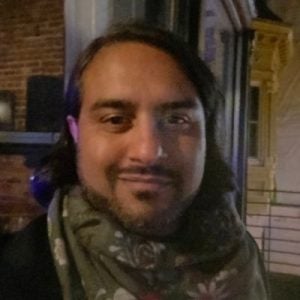 As he explains, “an idea of human rights is infused into your worldview because you just can’t escape it. You see it every day in terms of how people who are close to you are treated—the trials and tribulations, and hardships that your loved ones had to go through just to come to this country, seek safety, and find a modicum of protection.” He also recalls hearing about Israel’s occupation of Palestinian territory as a student in middle school—an experience which prompted him to explore political history, economics, and philosophy, and, in particular, questions of self-governance and self-determination.
While Raha himself was subjected to racial stereotyping growing up, he also realized that he had a level of privilege compared to his parents and broader family. Whereas Raha grew up in the United States, received an education here, and could speak, read, and write in English, his extended family, having come from India and Iran, had to contend with racial discrimination, profiling, and Islamophobia in a language and an environment that was unfamiliar to them. When reflecting on his upbringing, Raha shares, “I felt an obligation to use my privilege in a way that could advance what I felt was really important social justice work.”
Thus, Raha pursued a legal education at Georgetown to gain the knowledge and skills that would prepare him for a career in human rights and social justice advocacy. As a J.D. student, Raha took advantage of Georgetown’s strong reputation for public interest lawyering and dedicated his focus to gaining practical experience in the field. For instance, he immersed himself in public interest externships, led Georgetown’s Amnesty International Chapter as Co-President, served as Managing Editor of the Georgetown Journal of International Law (“GJIL”), and participated in the Human Rights Fact-Finding Project. Noting that there was a strong student demand for more human rights educational opportunities, Raha and other student leaders advocated for the recognition of the Human Rights Fact-Finding Project to be an accredited course, paving the way for its eventual evolution to becoming HRI’s Human Rights Fact-Finding Practicum and now the Human Rights Advocacy in Action Practicum. For his commitment to human rights work, Raha was recognized with the Bettina E. Pruckmayr Memorial Award upon graduation.
The education and training that Raha pursued at Georgetown helped launch an established career in human rights. For over a decade, Raha was on the front lines of addressing critical human rights concerns. For instance, he served in increasingly senior roles at Human Rights First over the course of a decade, and he worked on impactful campaigns such as one in the aftermath of 9/11 where he helped to mobilize a coalition of retired generals and admirals to rebuild a bipartisan consensus against torture. Following his time at Human Rights First, he served as the Director of Advocacy for Physicians for Human Rights, an organization that works at the intersection of medicine, science, and law to promote human rights for all.
Community-First Advocacy
Realizing his desire to work on behalf of those same communities which first instilled within him a passion for social justice, Raha joined NILC to represent immigrant communities directly. “I thought it could be interesting and also quite useful to bring a human rights framework to a bucket of issues, which is to say, immigrant rights and justice issues domestically within the United States.” Raha explains further, “the idea of migration—especially if you’re talking about refugees and asylum seekers, but even more broadly—is one of the foundational concerns of the modern international human rights framework.”
Raha now sees himself responding to a resurgence of the post-9/11 global war on terror framework, which is being used to justify the increasing use of emergency powers against immigrants in the United States. From the invocation of the Alien Enemies Act, which provides the President with the authority to detain or deport the natives and citizens of a hostile nation during wartime, to the mobilization of military and police power across the country, Raha and NILC are pushing back against the use of such government powers that threaten American democracy. Within their Democracy Defense initiative, which looks at the intersection of the rise of authoritarianism and immigration in the United States, NILC has created a Solidarity Guide to provide practical guidance for allies, educators, and community members to help protect immigrants and their neighbors against such threats.
As an advocate, Raha says the most important skill he relies on in his work is meeting people where they are. “If you come at an issue insisting that everybody needs to agree with you on not only the goal, but the way you’re talking about the issue and your moral frameworks, all of a sudden, the aperture starts to narrow dramatically in terms of the coalition that you can build.” To this end, he seeks to draw on those connections people have to immigration in their own communities and how, therefore, attacks against immigrants’ rights are not just abstract issues, but something that will impact their daily lives. “I think once people see that this is not actually a national security or counterterrorism issue, and this is much more about a project of white supremacy and a whole host of political projects that, frankly, most people don’t agree with and want nothing to do with, that’s how we can bring people along.”
Getting Involved and Carving a Path
For students seeking to get involved in human rights and social justice work, Raha emphasizes the benefits of practical experiences and creating a path that best fits your long-term career goals. “I think that there’s a lot of pressure out there that says you have to be the editor-in-chief of the International Law Journal or you’ve got to get a clerkship, and then you’ve got to be top of your class.” However, for Raha, “it was much more focusing on ‘How can I actually get those practical skills and experiences?’ and ‘How can I connect with people in the field to be able to build up my network?’” Acknowledging that the career landscape is always changing, he stresses, “do what feels right to you rather than what you think society expects you to be doing.” Raha encourages students to get involved in local networks, such as Migrant Solidarity Mutual Aid, and is open to helping students navigate and connect with other DC-based organizations.
Just as important, Raha urges students to remain involved in those activities that make them happy. “I think it’s important to carve out that time, because you will burn out. And you’re not doing anybody good if you’re burnt out, so self-care is super important.” For him and his friends, this was starting the Board Game Enthusiast Club, a hobby which he has kept up since graduating from Georgetown.
Written by Cameron Witbeck, edited by Michelle Liu